When reading recent US Supreme Court opinions interpreting BAPCPA, the statute’s manifest flaws are the "elephant in the room" (origins of phrase here), and Justice Kagan’s recent opinion for the Court in Ransom v. FIA Card Services , N.A, No. 09-907, 2011 WL 66438 (Jan. 11, 2011), is no exception.  She professes on behalf of the 8-1 majority to employ a traditional approach that looks to the "text, context, and purpose of the statutory provision at issue."  (Op. at 1.)  But it’s really all fiction, because the text is convoluted, the context is manufactured, and the purpose presupposed. 

In his last two lone bankruptcy dissents, Justice Scalia calls out the elephant in the room, even refusing in his latest dissent to be coerced (or better, ransomed) to join the bored and uncaring majority by a Chief Justice who shrewdly assigned this first (and traditionally unanimous) opinion to Justice Kagan, presumably in hopes of compelling Justice Scalia to stop his backbiting and join the team that finds sense in nonsense.

So the Court in Ransom held, seemingly innocuously so, that when determining the "disposable income" that a chapter 13 debtor has available to pay creditors over the 5 year life of a plan, the debtor has no deductible "car ownership cost" expense that can be shielded from creditors if he owns a car but does not make loan or lease payments on it.  While this decision may make eminent practical sense when considered in a vacuum by mandating that a debtor shield from creditors only actual payments and not theoretical payments drawn from an IRS manual, it is the Court’s reliance on "text, context, and purpose" that disappoints here because–as shown below–none prove the point.

For what bankruptcy judge or professional really believes that BAPCPA merits application of the rule that every word in a statute "carries meaning"?  (Op. at 8.)  Certainly Justice Scalia doesn’t.  (Dissent at 2, "The canon against superfluity is not a canon against verbosity.")  And I doubt most readers of this blog do either.  (See, e.g., here, here, here, here, here, and here.)

And is the Court properly confident that BAPCPA’s "context" mandates that a debtor "should be required to qualify for a deduction by actually incurring an expense in the relevant category"?  (Op. at 8.)  The "expense" that the Court mandates the debtor incur to be entitled to a "car ownership" deduction is in fact nothing more than a "debt" under a loan or lease that the statute itself unequivocally states can NEVER qualify as a deduction.  (See § 707(b)(2)(A)(ii)(I), "Notwithstanding any other provision of this clause, the monthly expenses shall not include any payments for debts.").  No problem, Justice Kagan writes, because "any friction between the two likely reflects only a lack of attention to how an across-the-board exclusion of debt payment would correspond to a particular IRS allowance."  (Op. at 15.)  And we’re supposed to believe that "meaning, context, and purpose" can be found in Congressional "lack of attention"?

Finally, Justice Kagan writes, the Court’s conviction in the correctness of the result is "strengthen[ed] [by] consideration of BAPCPA’s purpose … of  ensur[ing] that [debtors] repay creditors the maximum they can afford."  (Op. at 9.)  But I thought discretion in bankruptcy judges was precisely what BAPCPA was designed to eliminate!   See In re Pak, 343 B.R. 239 (Bankr. N.D. Cal. 2006) (Tchaikovsky, J.) ("BAPCPA did severely limit judicial discretion for above-median-income debtors").  And isn’t "ensuring that debtors repay creditors the maximum they can afford" through statutory gymnastics just another way of exercising judicial discretion on the grandest of all scales?

In the end, I prefer Justice Scalia’s reluctant dissent and side with his conclusion that "the Court’s interpretation does not, as promised, maintain ‘the connection between the means test and the statutory provision it is meant to implement.’"  (Dissent at 5.)  "Our job," he reminds all, "is not to eliminate or reduce [BAPCPA’s] oddities, but to give the formula Congress adopted its fairest meaning."  (Id.)  While I expect every member of the Court would agree with that statement, I also expect many more lone dissents by Justice Scalia as BAPCPA’s many splits wind their way up the chain.  But Justices Brennan and Marshall relentlessly dissented in every death penalty case, and Justice John Marshall Harlan was the lone dissent in Plessy v. Ferguson too.  Better to "stick to your guns principles" (dead phrase’s origins here) than to compromise them for a false unity.

                                  *                               *                              *                              *

Woe to Justice Kagan!  Forced in her first opinion to find Congressional meaning in a hastily-designed and poorly-crafted statute as to which (at least according to the highly-regarded US Bankruptcy Judge, Frank Monroe) "those responsible for … passing … did all in their power to avoid the proffered input from sitting United States Bankruptcy Judges, various professors of bankruptcy law at distinguished universities, and many professional associations filled with the best of the bankruptcy lawyers in the country as to the perceived flaws in the Act."  (Discussed here.)  Fittingly, Justice Scalia refused to "Ransom" his principles, and so thwarted the Chief Justice’s calculated designs, while most unfortunately dishonoring a Justice who deserved (albeit in another case) a unanimous first judicial opinion. 

And BAPCPA’s sad and unintended consequences thereby continue unabated.  (See others here, here, here, and here).

Thanks for reading!

© Steve Jakubowski 2011

Last year I spent about 75 hours creating an outline on the treatment of intellectual property licenses in bankruptcy for a PLI seminar, which I published here

PLI asked me back to speak next year at the 2011 Advanced Licensing Agreements seminar in Chicago on April 27-28.  I just updated last year’s outline, adding another 8 pages.  Here’s the clean version, and here’s the redline showing changes from last year’s draft.  I’m sure anyone involved with IP issues in bankruptcy will find peace of mind from this outline.

Happy holidays!

© Steve Jakubowski 2010

Busy lawyers often assume that it’s ok to skip a ministerial presentment hearing and await the Court’s order scheduling a hearing on the merits.  Today’s opinion from the 7th Circuit in United States v. Hyatt, reversing the finding of contempt and award of attorneys’ fees for failing to respond to two subpoenas served on them by the SEC, shows why it’s a BIG mistake to do so.   Here’s the background from the Court’s opinion:

The SEC initiated the contempt proceeding via a motion for a rule to show cause why Hollnagel and BCI should not be held in contempt.  The motion asked the court to: (1) order them to fully comply with the subpoenas; and (2) order them to show cause why they should not be held in contempt for their past noncompliance.  Accompanying this motion was a notice setting a date and time for a hearing at which the SEC said it would “present, and seek a hearing date regarding” its request for a show cause order. Hollnagel and BCI interpreted the notice and motion to mean that the initial hearing would be entirely ministerial—that the court would issue a showcause order and set another date on which the merits of
the contempt issue would be heard.  So they didn’t show up.

When the case was called and Hollnagel and BCI didn’t appear, the SEC skipped over the procedural preliminaries and moved right to the main event:  The agency’s lawyers asked the court to find Hollnagel and BCI in contempt.  The court did so, ordered them to fully comply with the subpoenas within two days, and imposed a $1,000-a-day fine for any noncompliance after that date.  The court later rescinded the fine, but left the contempt order in place and ordered Hollnagel and BCI to pay the [$33,000 in] SEC’s attorney’s fees, [which the district court later reduced to $6,000].

The 7th Circuit’s opinion is especially valuable for its discussion of whether show-cause orders are even contemplated by the Federal Rules of Civil Procedure (it concludes they are not despite the fact that lawyers "routinely ask for such orders to be issued" and courts in the district "regularly treat show-cause motions as distinct from other motions").  The opinion is also valuable for its review of the contempt sanctions available under Rule 45 for not complying with subpoenas issued by an attorney (it concludes that "[while] nothing in Rule 45 or the accompanying commentary purports to limit the contempt power to subpoenas issued with more direct district court involvement or to require an intervening court order when the subpoena is issued by an attorney … [i]t does not follow that a contempt motion for disobedience of a nonparty subpoena should be treated in exactly the same way as a contempt motion for violation of another kind of court order").

Notably, the day after the district court entered the contempt order, the non-party (BCI) filed a motion to vacate, arguing that it had been making reasonable efforts to comply with the subpoenas and therefore was not in contempt.  The district judge, however, denied the motion as moot because he thought BCI had waived its opportunity to contest the contempt finding by failing to show up at the September 3 hearing, and it was on this point that the 7th Circuit reversed and vacated the contempt order, saying:

Continue Reading 7th Circuit Shows How “An Ounce of Prevention Is Worth a Pound of Cure”

No shortage of interesting cases.  Here are a few that I posted on Twitter this past week.  RSS Feeds are also available

  • TX Dist. Ct. affirms decision requiring debtor to pay default rate of interest in cram down of secured claim in plan. http://ow.ly/1uofM
  • Bohm, J. examines whether Defendant filing a counterclaim in response to trustee’s complaint loses right to a jury trial. http://ow.ly/1unW8
  • Effective date of ch 11 plan ruled date conf. order became effective per the Code, not undefined date provided in plan. http://ow.ly/1unBe
  • §1104(c) not mandatory if movant lacks standing or waived rts under subord. agr. Ct also can signif. limit EX’s role. http://ow.ly/1tULO
  • Judge Gross on Target’s sale of Mervyns: §546(e) won’t apply to collapsed trX & T owed creditors a duty too under CA law. http://ow.ly
  • JAX BK Ct. won’t extend automatic stay to Canadian Church that has insuff. min. contacts with US to provide personal jd. http://ow.ly/1tqmx
  • Markell, J. dissects BAPCPA’s history and holds that the absolute priority rule doesn’t apply to individual’s ch 11 plan. http://ow.ly/1tq32

© Steve Jakubowski 2010

Here are my Twitter posts for the past week.  RSS Feeds are also available.
  • On remand from SCOTUS, 2d Cir says making Chubb’s claims against Travelers subject to 1986 confirmation order violates due process. http://ow.ly/1sbpL
  • Debtor’s failure to fund self-insured retention (SIR) doesn’t excuse insurer’s obligation to fund defense costs above SIR. http://ow.ly/1s9Yj
  • 7th Cir. reverses Grede v BoNY: Caplin’s limits on BK trustee’s standing don’t apply to post-confirm. liquidating trust. http://ow.ly/1rJxC
  • Can a man’s ch.7 case be transferred to his first-filed ch.7 affiliate’s foreign ct per Rule 1014(b)? This brief says no! http://ow.ly/1rs7e
  • Philly News sues lenders to extend DIP maturity:says they are retaliating for investigation of "illegal" taping of pre-BK mtg. http://ow.ly/1r133
  • Most notable point in oral arg on my appeal of GM sale: Harvey Miller saying filed proofs of claim total $129B & are mostly products claims.

May your Passover and Easter holidays be meaningful!

Thanks for reading!

© Steve Jakubowski 2010

As first noted here, I’ve been posting nearly daily on Twitter a bankruptcy case highlight or development that I don’t want to clutter this blog with.  RSS Feeds are also available, so you don’t need a Twitter account to access them.

Here are my posts for the week ended 3/22/2010:

  • Valukis report’s glaring omission-E&Y’s fate depends on how NY Ct of Appeals decides questions certified in Refco & AIG-http://bit.ly/buw6Z4
  • Oral argument set before Judge Buchwald in GM Tort Claimants’ appeal for 3/24/10, 10:30 am, Rm 21A, SDNY, 500 Pearl St. http://bit.ly/ajh2Mk
  • 9th Cir reverses jdgmt for Anna Nicole, finding that TX probate ct’s earlier findings & legal conclusions were binding. http://bit.ly/bWaMFu
  • New blog post on Anna Nicole Smith’s loss on preclusion grounds in fight with Pierce over rights to J. Howard’s money. http://bit.ly/99Ia8Q
  • 3d Cir rules 2-1 that Secured Lender has no absolute right to credit bid in a cramdown. Spirited dissent by Ambro, J. http://ow.ly/1pvau

© Steve Jakubowski 2010

6/24/11 Update:  Here’s my blog post providing an early analysis of the US Supreme Court’s final 5-4 decision in favor of Pierce’s estate, entitled US Supreme Court’s Bombshell Opinion in Stern v. Marshall Draws the Line Against Incremental Erosion of Article III Judicial Power.

*          *          *          *

6/23/11 Update:  5-4 decision delivered affirming 9th Circuit’s ruling and handing Pierce Marshall’s estate a complete and final victory.  Justice Roberts with an extremely well written opinion; Justice Breyer dissenting. Opinion here.  Pre-opinion writeup here.

*          *          *          *

And so, it appears, 19 years of hell for the remaining surviving heirs of J. Howard Marshall II come near an end.  Here’s the chronology:

  • First, in October 1991, the so-called "courtship" between J. Howard and Anna begins.
  • In April 1995, Anna sues J. Howard’s son and guardian, Pierce, in Texas Probate Court (amended several times after J. Howard’s death) for, among other things, tortious interference with her expectation of support during the marriage and after his death and for fraud and undue influence in connection with J. Howard’s estate planning.
  • In August 1995, J. Howard dies, leaving her nothing.
  • In January 1996, Anna files bankruptcy. 
  • In May 1996, Pierce brings a non-dischargeability adversary for defamation.
  • In June 1996, Pierce files a corresponding proof of claim in Anna’s bankruptcy case. 
  • In June 1996, Anna counterclaims in bankruptcy, asserting the same claims she made in probate court.
  • In October 2000, the bankruptcy court rules against Pierce on the defamation claims and, in December 2000, it enters a $475 million judgment in favor of Anna on the counterclaims.  Marshall v. Marshall, 253 B.R. 550 (Bankr. C.D. Cal. 2001).
  • In January 2001, Pierce appeals. 
  • In January 2001, Anna nonsuits her claims against J. Howard’s estate and Pierce individually in probate court.
  • In February 2001, Pierce files an amended counterclaim against Anna in probate court for declaratory relief to determine her rights to the estate and property of J. Howard and a complaint for a declaratory judgment against Anna and J. Howard’s estate that J. Howard’s Living Trust reflected his intentions and were valid.
  • In March 2001, after a five month jury trial in the Texas Probate Court, the jury unanimously finds that the Living Trust and will were valid and had not been forged or altered, that J. Howard wasn’t the victim of fraud or undue influence, that J. Howard had the requisite mental capacity at all relevant times, and that J. Howard had no agreement with Anna to give her 1/2 of all his property.
  • In December 2001, the probate court enters final judgment in favor of Pierce on all claims, holding that Pierce was entitled to his inheritance, free from all claims by Anna or Pierce’s older brother.
  • After the jury verdict in probate court, Pierce moved to dismiss Anna’s claims against him in district court on the appeal of the bankruptcy court ruling on grounds of claim and issue preclusion, but the district court denied this motion in December 2001.  Marshall v. Marshall, 271 B.R. 858 (C.D. Cal. 2001).
  • In March 2002, the district court entered judgment in favor of Anna, finding that "J. Howard always intended to give [Anna] … half of his ‘new community’" (i.e., the appreciation of his estate during their marriage) and that Pierce "backdated documents, altered documents, destroyed documents, suborned falsified notary statements, presented documents to [J. Howard] under false pretenses, and committed perjury,” in order to deny any distributions to Anna from J. Howard’s estate.  In re Marshall, 275 B.R. 5 (C.D. Cal. 2002).
  • In 2004, the 9th Circuit vacated the judgment against Pierce on the basis that the so-called probate exception to federal subject matter jurisdiction precluded consideration of the case.  Marshall v. Marshall (In re Marshall), 392 F.3d 1118 (9th Cir. 2004).
  • In 2005, the US Supreme Court granted Anna’s petition for certiorari, as I discussed here, here, here, and here.
  • On May 1, 2006, as discussed here, here, here, and here, the US Supreme Court reversed the 9th Circuit’s decision, concluding that the probate exception did not apply to Anna’s in personam counterclaims against Pierce.  The 9th Circuit only considered the issue of federal subject-matter jurisdiction.  The Supreme Court remanded for consideration of whether Anna’s claims were "core" and whether Anna’s claims were barred under principles of claim and issue preclusion based on the earlier judgment entered in the Texas Probate Court.  Marshall v. Marshall, 547 U.S. 293 (2006).
  • Finally, and that’s the purpose of this post, the 9th Circuit concludes on March 19, 2010, that Anna’s counterclaim is not a core proceeding but, at most, "related to" her bankruptcy case.  As a result, the earlier judgment entered in her favor by the bankruptcy court was not final at the time that the Texas Probate Court entered its judgment in favor of Pierce, and so the Texas Probate Court judgment was the earliest final judgment that precludes all of Anna’s claims.  Marshall v. Stern (In re Marshall), No. 02-56002, 2010 WL 986781 (9th Cir. Mar 19, 2010) (NO. 02-56002) (pdf).

The 9th Circuit’s opinion is certainly worth reading for many reasons.  First, it provides an excellent review of "the evolution of the current bankruptcy regime in order to appreciate the important distinctions between ‘arising under,’ ‘arising in,’ and ‘related to’ proceedings and how the notion of ‘core’ proceedings came to exist."  (Idat p. 4508).  The case also is interesting in its analysis of how "counterclaims by the estate against persons filing claims against the estate"―that by statute (28 U.S.C. § 157(b)(2)(C)) are defined as "core"―can still be narrowly construed as non-core "in order to avoid potential constitutional problems arising from having Article I judges issue final orders in cases requiring an Article III judge."  (Idat p. 4521).  Even compulsory counterclaims may not be "core" proceedings, the Court held, writing:

Continue Reading 9th Circuit Declares Anna Nicole Smith’s Estate the Big Loser on Preclusion Grounds in Dispute with Pierce’s Estate Over Her Right to Money from J. Howard Marshall’s Estate

As noted in this post, last week I started posting on Twitter, which has a 140 character limit per post.  These are my posts for the week ended 3/14/2010:

  • Judge Wedoff to decide on confirmability of a plan where the crammed-down lender can’t credit bid. Briefs here: http://tinyurl.com/yg3mwbe
  • New blog post on SCOTUS’ free speech decision in Milavetz on this169th anniversary of Justice OW Holmes’ birthday. http://tiny.cc/OZdy2
  • 7th Cir-BK standing narrower than Art. III. "Person aggrieved" in BK must appear, object, & have pecuniary interest. http://tiny.cc/f7voh
  • Judge Wedoff says he’d reject a plan denying a crammed down lender a right to credit bid, but the issue was moot bec the plan was withdrawn.
  • KERP denied on remand in MD BK Ct. bec of lack of competing employment offers. Asset purchaser’s offer doesn’t count. http://tiny.cc/pG1Py

Thanks as always for reading.

© Steve Jakubowski 2010

Back in the good old days when bashing BAPCPA was in vogue, I posited here that BAPCPA’s "debt relief agency" provisions "look more like an effort to create a consumer bankruptcy lawyer clone who, much like the ever-multiplying Agent Smith from The Matrix-Reloaded, speaks and does precisely as directed with ruthless efficiency."  Today’s unanimous opinion from Justice Sonia Sotomayor (with concurrences from Justices Scalia and Thomas) tells us not to worry because while attorneys in fact are "debt relief agents" under the Code, §526(a)(4) "prohibits a debt relief agency only from advising a debtor to incur more debt when the impelling reason for the advice is the anticipation of bankruptcy."  Milavetz, Gallop & Milavetz, P.A., v. United States, No. 08-1119 (Op. at 13). 

As with most bankruptcy decisions from the Supreme Court, the path taken to the holding is more interesting than the actual holding itself.  This post examines two aspects of that road:

  • First, the Court’s discussion of the application of the "plain meaning" rule and the relevance of legislative history; and
  • Second, the Court’s recognition of the ethical boundaries of the attorney-client relationship and, in particular, the line where advice crosses into conspiracy. 

1.     Attorneys as "Debt Relief Agents" and Footnote 3’s "Bridge Too Far"

This first conclusion comes as no surprise as the attorneys’ arguments "failed to persuade [the Court] to disregard the statute’s plain language."  (Op. at 7).  But rather than stop at plain meaning, the Court dropped a footnote finding support for the plain meaning in BAPCPA’s legislative history (Op. at 6, n. 3).  This single footnote prompted Justice Scalia to write a separate concurring opinion just so that he could attack the premise of Footnote 3.

In Part II, Section B of my BAPCPA outline, entitled BAPCPA’s "Plain Meaning" Not Followed, I reviewed five cases in the first year following BAPCPA’s enactment where bankruptcy judges were so confounded by BAPCPA that they felt compelled to deviate from its "plain meaning" in order to avoid virtually nullifying certain of its key provisions.  Justice Scalia’s concurrence highlights the problem facing bankruptcy lawyers who attempt to rely upon the legislative history of BAPCPA for interpreting an ambiguous statutory provision.  He wrote:

I join the opinion of the Court, except for footnote 3, which notes that the legislative history supports what the statute unambiguously says.  The Court first notes that statements in the Report of the House Committee on the Judiciary “indicate concern with abusive practices undertaken by attorneys.”  Ante, at 6, n. 3.  Perhaps, but only the concern of the author of the Report.  Such statements tell us nothing about what the statute means, since (1) we do not know that the members of the Committee read the Report, (2) it is almost certain that they did not vote on the Report (that is not the practice), and (3) even if they did read and vote on it, they were not, after all, those who made this law.  The statute before us is a law because its text was approved by a majority vote of the House and the Senate, and was signed by the President.  Even indulging the extravagant assumption that Members of the House other than members of its Committee on the Judiciary read the Report (and the further extravagant assumption that they agreed with it), the Members of the Senate could not possibly have read it, since it did not exist when the Senate passed the Bankruptcy Abuse Prevention and Consumer Protection Act of 2005.  And the President surely had more important things to do.

The Court acknowledges that nothing can be gained by this superfluous citation (it admits the footnote is “unnecessary in light of the statute’s unambiguous language,” ante, at 6, n. 3).  But much can be lost.  Our cases have said that legislative history is irrelevant when the statutory text is clear. See, e.g., United States v. Gonzales, 520 U.S. 1, 6 (1997); Connecticut Nat. Bank v. Germain, 503 U.S. 249, 254 (1992).  The footnote advises conscientious attorneys that this is not true, and that they must spend time and their clients’ treasure combing the annals of legislative history in all cases:  To buttress their case where the statutory text is unambiguously in their favor; and to attack an unambiguous text that is against them.  If legislative history is relevant to confirm that a clear text means what it says, it is presumably relevant to show that an apparently clear text does not mean what it seems to say.  Even for those who believe in the legal fiction that committee reports reflect congressional intent, footnote 3 is a bridge too far.

2.     § 526(a)(4)’s Narrow Scope Does Not Impair the Attorney-Client Relationship

Here, the Justices unanimously agree that § 526(a)(4)’s prohibition against a debt relief agent’s "advis[ing] an assisted person … to incur more debt in contemplation of" filing for bankruptcy is limited to "advising a debtor to incur more debt because the debtor is filing for bankruptcy, rather than for a valid purpose."  (Op. at 13).  To the Court, the "controlling question … is whether the impelling reason for ‘advis[ing] an assisted person … to incur more debt" was the prospect of filing for bankruptcy."  Additionally, the Court held, "’load[ing] up’ on debt with the expectation of obtaining its discharge … is abusive per se"  (Op. at 14) (emphasis added).  (That should seal the fate of those debtors fighting dischargeability under Sections 523(a)(2), (4), and (6) who "loaded up on debt" in advance of the filing).
 
Equally important for those looking for guidance on the Court’s tools of statutory interpretation in bankruptcy is the Court’s statement, citing United States v. Granderson, 511 U.S. 39, 55 (1994):  "That ‘[n]o other solution yields as sensible a’ result further persuades us of the correctness of this narrow reading."  (Op. at 15).  The Court reasoned:

Continue Reading US Supreme Court on Justice Holmes’ 169th B-day Holds in Milavetz that the Bankruptcy Code’s Speech Restrictions on Attorneys Do Not Turn Them into Ruthless Drones

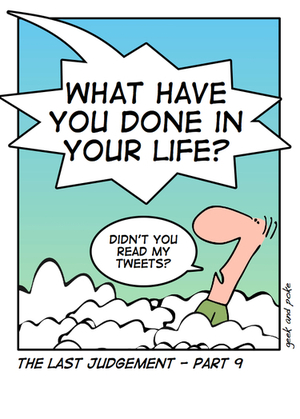
Listening to Kevin O’Keefe at the Emory Symposium describe twittering as perhaps the most important branding tool since the advent of television (an obvious exaggeration, but point taken), I decided to finally start Twittering as a complement to blogging.  I started this blog in 2005 as an alternative to pointless, incessant barking, and I’ve tried to maintain it as a resource of substance, not triviality.  Still, it’s clear there’s a definite place for barking in bankruptcy, and that’s where Twitter, with its 140 character limit, fits in.  So, last Thursday, I started twittering.  Here are my latest two posts:

The past 4 years of blogging have generated over 500,000 page views.  Today I have just 21 followers on Twitter, but you’ve got to start somewhere.  Those interested in hearing me bark on bankruptcy should click here and "Follow Me on Twitter."  Here’s the RSS Feed link to my Twitter posts.

Thanks for reading and following!

© Steve Jakubowski 2010