Many have anxiously awaited more updates to my BAPCPA outline.  But every time I’m about to turn to another section, some new decision, argument, or news bit distracts me from posting additional sections.  At the rate things are going, and given the increasing cacophony of case law, the present outline soon will become as dated as a baby boomer at a high school reunion.
So, with trees finally changing colors here in Chicago, I too have decided to turn over a new leaf and, in this last of 9 installmentsmake the entire outline available for your viewing (or soporific) pleasure.  Hopefully, it will provide those of you toiling in BAPCPA’s consumer trenches with a useful and structured platform from which to further analyze the issues you’re facing.

Given the nature of my practice and the competing demands on my time, it’s not likely that I’ll be updating the outline to accommodate the next year’s cases.  At the rate they’re coming down, including them all in an outline is as daunting a task as trying to herd cats or capture steam.  Indeed, the draft I had started already is about 50 pages after only a couple of months.  But, never say never….

Thanks to all for the great support you’ve shown to my efforts and best of luck in all your endeavors!

© Steve Jakubowski 2006

Practitioners before the Seventh Circuit Court of Appeals know that oral arguments in that Court can sometimes go well (e.g., by following the guidelines set forth in Question 4 here), and sometimes not so well (see here), and that one’s success, failure, and/or embarrassment at oral argument may well hinge upon the panel drawn.

Counsel to the United Airlines Retired Pilots’ Benefit Protection Association in preparing to argue the Retirees’ appeal of United Airline’s plan confirmation order surely had to be concerned upon learning that he had drawn a panel consisting of Judges Posner, Easterbrook, and Bauer.  As suggested here, one planning to argue a weak case before this group of heavyweights may as well throw away the script and pray to the Almighty for forgiveness because failure and embarrassment are the likely outcomes of such a test.

The Retirees’ appeal presented the Court with two primary issues: 

First, whether the UAL’s plan unfairly classified and treated active pilots differently from retired pilots in respect of their respective claims resulting from termination of pension benefits.

Second, whether the reorganization plan appropriately included exculpatory releases that shielded the union for the active pilots from claims that the retirees may desire to assert against the union.

In yesterday’s oral argument (accessible here), Judge Posner took the lead in peppering the retirees’ counsel with questions.  Judge Posner provides litigators a lesson in the importance of answering the precise question asked, regardless of how damaging the answer may be to one’s case.  Here, while pressing the retirees’ counsel to answer his question as to how this appeal is not a direct attack on Judge Posner’s ruling last March (holding that the bankruptcy court could approve UAL’s agreement with the active pilots’ union providing for differential treatment that favored the active pilots interests over those of the retired pilots), Judge Posner had this to say in response to counsel’s failure to respond directly to the question asked:

Continue Reading Seventh Circuit Appears Ready to Ground Retired Pilots’ Challenge to United Airline’s Confirmation Order

The following comparative bankruptcy-related papers, arranged by abstract ID number, can be downloaded from the Social Science Research Network:

***

Tillberg University’s Harry Huizinga, Int’l Monetary Fund’s Luc Laeven, and Free Univ. of Brussels’s Gaetan Nicodeme: "Capital Structure and International Debt Shifting."  (Abstract ID: 918460)

***

Univ. of Cantabria’s Carlos Lopez Gutierrez, Myriam Garcia Olalla, and Begoña Torre Olmo: "Economic Valuation of the Efficiency of Bankruptcy Systems." (Abstract ID: 917784)

***

Nottingham Trent University’s Adrian Walters and Univ. of Aberdeen’s Donna W. McKenzie Skene: "Consumer Bankruptcy Law Reform in Scotland, England and Wales." (Abstract ID: 914552)

***

Univ. of N. Dakota School of Law’s Jason Jeremy Kilborn: "Out with the New, In with the Old: As Sweden Aggressively Streamlines its Consumer Bankruptcy System, Have U.S. Reformers Fallen Off the Learning Curve?" (Abstract ID: 913096)

***

Anuradha Sen: "The Bankruptcy Laws: Comparing Russia, USA, Canada, and UK." (Abstract ID: 912931)

***

Catholic Univ. of Leuven’s Nico Dewaelheyns and Cynthia Van Hulle: "Legal Reform and Aggregate Small and Micro Business Bankruptcy Rates: Evidence from the 1997 Belgian Bankruptcy Code." (Abstract ID: 905196)

***

York University’s Iain D.C. Ramsay: "Functionalism and Political Economy in the Comparative Study of Consumer Insolvency: An Unfinished Story from England and Wales." (Abstract ID: 900419)

 ***

Univ. of Bologna’s Luca Enriques and Vienna University’s Martin Gelter: "How the Old World Encountered the New One: Regulatory Competition and Cooperation in the European Corporate and Bankruptcy Law." (Abstract ID: 887164)

***

Bard College’s Guillermo Le Fort: "Financial Crisis in Developing Countries and Structural Weaknesses of the Financial System." (Abstract ID: 884718)

***

IMF Researcher Se-Jik Kim: "Corporate Leverage, Bankruptcy, and Output Adjustment in Post-Crisis East Asia." (Abstract ID: 880670)

***

Harvard University’s Kenneth Rogoff and Jeromin Zettelmeyer: "Early Ideas on Sovereign Bankruptcy Reorganization: A Survey." (Abstract ID: 879533)

***

Harvard University’s Kenneth Rogoff and Jeromin Zettelmeyer: "Bankruptcy Procedures for Sovereigns: A History of Ideas, 1976-2001." (Abstract ID: 879911)

***

Abstracts for each of these papers follows:

Continue Reading Recent Comparative Bankruptcy-Related Articles of Interest Available for Downloading from SSRN

Though its origins are murky, the slang phrase "duck soup" is typically understood to mean "a piece of cake" or "something that is easily done." 

The Marx Brothers made the phrase famous in their movie Duck Soup, which Roger Ebert calls "probably the best" of the Marx Brothers’ movies (though contemporary audiences apparently didn’t think so).  

In hearing of New York Bankruptcy Judge Burton Lifland’s ruling that denied Dana Corp.’s proposed incentive plan for its executives as a disguised retention plan prohibited by BAPCPA’s new Code section 503(c) — and his statement  in open court that "this compensation scheme walks like, talks like, and is a KERP" — I was reminded (speaking of "movies with corporate themes") of the opening segment in Duck Soup where Groucho Marx, as the newly inaugurated dictator/president of bankrupt Freedonia (or perhaps, more aptly, "Free-Dan-[i]-a"), outlined his own bonus incentive plan in the movie’s opening sequence:

I will not stand for anything that’s crooked or unfair
I’m strictly on the up and up
So everyone beware
If anyone’s caught taking graft
And I don’t get my share
We stand ’em up against the wall
And pop goes the weasel.

You’ll find some good early commentary on Judge Lifland’s decision here (WSJ Blog),  here (CFO.com), here (Boss & Workplace Blog), here (Bankr. & Restr. Blog), here (Credit Slips Blog), and here (Credit Slips Blog).  As noted here (in connection with his successful mediation of the dispute in the Enron bankruptcy over Stephen Cooper’s $25 million "success fee" request), Judge Lifland is no stranger to compensation fights.  Indeed, his legendary experience on the bench makes his decision all that much more signficant.

Given the ease with which Calpine Corporation’s proposed incentive plan sailed through Judge Lifland’s court only four months earlier, Dana’s advisers (as reported here) "had been confident they would prevail, in large part because … the Dana pay package was modeled on one adopted [in] Calpine."  In approving the Calpine plan, Judge Lifland commented from the bench:

Well, based upon this record, and it’s certainly clear to the court that these plans and agreements are proposed in good faith and based upon appropriate business judgment. Further, the record before me validates that the focus of the plans and agreement is to maximize value for all the estates; the plans are apparently designed as incentive plans as opposed to retention or KERP’s.

I do find, based upon this record, that the prohibitions of Section 503 have, if not been avoided, are not applicable based upon the structure of these plans and the agreements. To the one area where there might be potentially an argument to be made that 503(c) would be applicable, that would be in the supplemental plan, but that does not involve insiders, and I think 503(c)(3) is appropriately analyzed to agree with that.  In short, I do agree that these are incentive plans to bring enhanced value into the estate. They are not retention plans, although anyone can always make an argument that if people are made happier than they were before, then they are excited enough to stay with the company, but that’s not the focus of these plans. And this would be clearly, based upon this record, not KERP’s and they are not in violation of 503(c). And I will approve the appropriate orders submitted.  (See Transcript at pp. 84-85.)

Here’s a copy of the order entered by Judge Lifland in the Calpine bankruptcy case, to which the approved Calpine incentive plan is attached as Exhibit A.  For the sake of completeness.  Here also you’ll find the Debtor’s motion to approve the incentive plan, the sole objection filed by a small, outgunned Calpine shareholder, and the Debtor’s reply in support.  At the near "rubber-stamp" hearing approving the plan, Judge Lifland heard offers of proof from Scott Davido, Calpine’s CFO/CRO, and Nick Bubnovich, a senior consultant from Watson Wyatt (who also provided some benchmarking testimony), as well as statements in support of the incentive plan from Akin Gump’s Mike Stamer on behalf of Calpine’s Official Unsecured Creditors’ Committee.

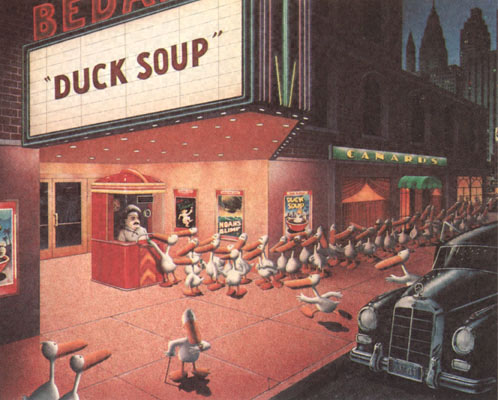
Approving Dana Corp.’s proposed incentive plan, however, proved to be anything but "duck soup" for veteran bankruptcy lawyer Corinne Ball and her legions at Jones Day in this hotly contested proceeding.  Instead, Judge Lifland wrote in striking down Dana’s proposed compensation arrangements, "if it walks like a duck (KERP), and quacks like a duck (KERP), it’s a duck (KERP)."  In re Dana Corp., 2006 WL 2563458 (Bankr. S.D.N.Y. 9/5/06) (pdf).  He continued:

The Completion Bonus includes an amount payable to the Executives upon the Debtors’ emergence from chapter 11, regardless of the outcome of these cases. Without tying this portion of the bonus to anything other than staying with the company until the Effective Date, this Court cannot categorize a bonus of this size and form as an incentive bonus. Using a familiar fowl analogy [see "duck" quote above], this compensation scheme walks, talks and is a retention bonus. Contrary to the contentions of several objectors, however, the language of section 503(c)(3) does not prevent this Court considering a Compensation Motion using the business judgment rule….

The Debtors have failed here to meet their burden of demonstrating that the payments in exchange for signing a non-compete agreement and other payments do not constitute “severance” for purposes of section 503(c)(2) of the Bankruptcy Code, or that the evidentiary requirements contained in section 503(c)(2) have been satisfied.

In explaining why he approved a comparable plan in Calpine’s bankruptcy case, but would not do the same in Dana’s, Judge Lifland remarked:

The Debtors also compare the compensation programs brought before other courts, in other cases, including the plan brought before this Court in In re Calpine. If this Court is to analyze the Compensation Motion pursuant to section 503(c), the Court must look to the specific circumstances of these cases, and these Debtors. A significant aspect of these cases, in the context of the Compensation Motion, are the issues raised in the strong objections filed by several parties in interest, including the Creditors’ Committee, Equity Committee and United States Trustee and therefore, the Compensation Motion cannot fairly be compared to other compensation motions brought before this Court or other courts. Finding support in this Court’s bench ruling in In re Calpine is misplaced as in that case there was a prima facie case and record to support the application for an "incentive” that was largely unrebutted, therefore not raising the issues currently before this Court.

Or, put another way, "fool me once, shame on you; fool me twice, shame on me."

For those interested, below you’ll find links to all the pleadings (with exhibits) filed by Dana and the objecting parties in connection with the matter.  Taken as a whole, they make for some fascinating and enlightening reading:

Continue Reading Duck Soup: NY’s Judge Burton Lifland Nixes Dana Corp.’s “Incentive” Plan for Its Top Six Executives

The following bankruptcy history-related papers, arranged by abstract ID number, can be downloaded from the Social Science Research Network:

***

American University’s Mary Hansen and Univ. of Mary Washington’s Bradley Hansen: "Path Dependence in the Development of U.S. Bankruptcy Law, 1880-1938." (Abstract ID: 909294)

***

Rutgers University’s Paul J. Miranti Jr. and Drexel University’s Nandini Chandar: "Information, Institutions and Agency: The Crisis of Railroad Finance in the 1890s and the Evolution of Corporate Oversight Capabilities." (Abstract ID: 899415)

***

UW-Madison’s Jodi L. Bellovary and Marquette University’s Don E. Giacomino and Michael D. Akers: "A Review of Bankruptcy Prediction Studies: 1930 to Present." (Abstract ID: 892160)

***

Abstracts for each of these papers follow:

Continue Reading Recent Bankruptcy History-Related Articles of Interest Available for Downloading from SSRN

With chapter 11 filings at the lowest level in 10 years, the world awash with liquidity, and default rates at historic lows, a recent post on the excellent Econobrowser blog last week caught my eye when it suggested that recent yield-to-maturity data "yields a probability-of-recession estimate of 44.3%."

Yesterday’s Reuters news bulletin, pointing to a study released yesterday by the Federal Reserve Bank of NY, further confirmed that the future may not be quite as rosy as present default rates (or, alternatively, bankruptcy lawyer billable hours) suggest.

This study, authored by Arturo Estrella (senior vice president in the Capital Markets Function of the Research and Statistics Group at the Federal Reserve Bank of NY) and Mary Trubin (former economist at the FRB who is now on track to get a Ph.D. in economics at Northwestern U.), concludes that a curve inversion lasting at least three months can signal a recession 12 months before it actually happens.  According to the study, the minimum spreads between three-month and 10-year yields ranged as much as -3.51% prior to the August 1981 to November 1982 recession, to as small as -0.08% before the August 1990 and August 1991 recession.

Thus far, according to yesterday’s news release, 3-month yields have exceeded 10-year yields since mid-July.  The 10-year/3-month spread is presently about -0.26%.

Place your bets!

© Steve Jakubowski 2006

The following bankruptcy finance-related working papers, arranged by abstract ID number, can be downloaded from the Social Science Research Network:

***

Brandeis University’s Jens Hillscher and Harvard University’s Jan Szilagyi: "In Search of Distress Risk." (Abstract ID: 917567)

***

FDIC’s Michael Kimminger: "The Evolution of U.S. Insolvency Law for Financial Market Contracts." (Abstract: 916345)

***

Seton Hall Univ. School of Law’s Stephen Luben: "Credit Derivatives & the Future of Chapter 11." (Abstract ID: 906613)

***

Stockholm School of Economics’s Stefano Rossi and Stockholm University’s Nicola Gennaoli: "Bankruptcy, Creditor Protection and Debt Contracts." (Abstract ID: 891154)

***

Northwestern University’s Vadim Linetsky: "Pricing Equity Derivatives Subject to Bankruptcy." (Abstract ID: 889973)

***

University of Mainz’s Gunther Friedl: "Discussion of ‘Optimal Debt Service: Straight vs. Convertible’." (Abstract ID: 899299)

***

Penn. State Univ.-Berks’s Khaled Abdou and Univ. of New Orleans Oscar Varela: "The Role of Venture Capitalists in Bankruptcy." (Abstract ID: 891642)

***

University of Aarhus’s Peter Tind Larsen: "Default Risk, Debt Maturity and Levered Equity’s Risk Shifting Incentives." (Abstract ID: 887441)

***

University of Chicago Law School’s Kenneth W. Dam: "Credit Markets, Creditors’ Rights and Economic Development." (Abstract ID: 885198)

***

Univ. of Georgia’s Mark Dawkins and Linda Smith Bamber and SMU’s Neil Battacharya: "Systematic Share Price Fluctuations after Bankruptcy Filings and the Investors who Drive Them." (Abstract ID: 881508)

***

Abstracts for each of these papers follow.  More importantly, thanks to all who expressed their condolences to me during the past week regarding my mom’s recent passing.  Your support provided a source of much comfort to me.

Continue Reading Recent Bankruptcy Finance-Related Articles of Interest Available for Downloading from SSRN