[6/18/09 Update:  Those looking for my post on today’s Travelers v. Bailey decision can find it here.  This post is about the 2007 decision in Travelers v. PG&E.]

In arguing against cameras in the courtroom in recent testimony before the Senate, Supreme Court Justice Anthony Kennedy noted the special rules of etiquette that govern proceedings before the US Supreme Court.  He said:

We have a language, and ethic and etiquette, a formality, a tradition that’s different than the political branches; not better, not worse, but different.

One of those traditions, embodied in Supreme Court Rule 14.1(a) and many, many Supreme Court cases (e.g., Hines Yellow Pine Trustees v. Martin, 268 U.S. 458, 465, 45 S. Ct. 543 (1925)), is that you don’t raise new issues for the first time in merits briefs on cases before the Court.  Yet that’s exactly what PG&E did in Travelers Casualty and Surety Co. of Am. v. Pacific Gas and Elec. Co., No. 05-1429, 2007 WL 816795 (3/20/07) (pdf), and the Justices were clearly none too pleased about it.  After all, certiorari had been granted for the sole purpose of resolving the conflict among the circuits regarding the validity of the 9th Circuit’s so-called “Fobian rule” (which provides that attorney fees are not recoverable in bankruptcy for litigating issues peculiar to federal bankruptcy law).  (Op. at 4, 7-8.)  And to make matters even worse, PG&E’s counsel admitted at oral argument that the both sides agree (though for different reasons) that the Fobian rule is wrong!  (Op. at 10.) 

Instead of advising the Court in its opposition to the petition for certiorari that it agreed with the petitioner that Fobian was wrong, however, PG&E raised for the first time in its merits response brief why a fair reading of the Bankruptcy Code makes Fobian right, though not for the reason upon which certiorari was granted.  Chief Justice Roberts hoisted PG&E’s counsel on his own petard in calling PG&E’s tactics “an ambush and … a smuggling in the sense we don’t have a Court of Appeals decision one way or the other on that question.”  (Oral Arg. Tr. at 28:1-4.)  Justices Stevens and Ginsburg echoed Chief Justice Roberts’ displeasure with the following exchange (Tr. at 28:17-29:2):

Justice Stevens: Well, why then isn’t the proper disposition of this case to send it back to the Ninth Circuit to consider all these other arguments?

PG&E Counsel: Well, Your Honor, because this issue has been fully ventilated among the lower courts.

Justice Ginsburg: Yes, but we are not a court of first view and you know that very well. We are a court of review. So no matter how well it’s been aired [in other circuit cases], we wait to see what the lower courts have said on a question. We don’t take it in the first instance.

Still, the Justices made the best of the situation, and seemed genuinely interested in exploring the question of whether unsecured creditors have a right to attorneys’ fees expended postpetition.  But, as explained here (Credit Slips blog), here (In the Red Business Bankr. Blog), here (SCOTUS blog), and here (Georgia Bankr. Blog) the case was an easy one to decide because there wasn’t a soul in the entire Supreme Court that day who believed that Fobian was correctly decided.

The task of drafting the opinion fell to Justice Alito, author of the Marrama dissent, who didn’t ask a single question at oral argument.  His opinion is straightforward, but noteworthy for at least reminding us of several fundamental principles of law that remain in the forefront of the Supreme Court’s bankruptcy jurisprudence.  They are:

Continue Reading US Supreme Court Expresses Supreme Displeasure at PG&E’s “Ambush and a Smuggling”

A year ago, I voiced my concerns in a post entitled "The Subprime Squeeze" that the dramatic "hockey stick" growth in housing’s subprime lending market was "more likely caused by looser adherence to underwriting standards than by increased demand for subprime products among qualified borrowers."  "If, in fact, looser credit standards have driven the current exponential growth since 2000 in subprime lending," I predicted, "then waves of defaults will be ‘tsunami-like’ in proportion."  Last Memorial Day, I echoed these sentiments in this post.

Well, "the chickens are coming home to roost," as the old saying goes, and the subprime squeeze is looking to some (such as Professor Nouriel Roubini) more like a hangman’s noose.

Courtesy of the TPM Cafe Blog, here’s a great read from Credit Suisse entitled "The Impact of the 2005 Bankruptcy Law on Subprime HEL [Home Equity Loans]."  Here are the conclusions of the report:

•   We believe that the new bankruptcy law introduced on October 17, 2005 has had a profound impact on subprime borrowers.  Under the new law, we find that bankrupt borrowers are riskier. Under the new law, the means test is more difficult to pass for bankruptcy petitioners, and more subprime mortgagor filers are required to enter Chapter 13 rather than Chapter 7 bankruptcy, even though they might not be able to complete the repayment plan.  Our analysis reveals that a higher percentage of borrowers are failing their bankruptcy repayment plans.

•   The stringent means test also means more delinquent loans have to go into foreclosure directly rather than into bankruptcy.  Therefore, it is directly responsible for the rising foreclosure rate since the end of 2005.

•   We believe that the cash flow from bankrupt filers is lower after the new law, and the cure rate from bankruptcy has declined.

•   The roll rate pattern since October 2005 indicates that roll rate data prior to the bankruptcy law change should be used with caution, as it overstates the cure rate and can have a non-trivial impact on delinquency and trigger projections.

Remember the old maxim, "bad cases make bad law" (cited as a "rule" in this 1845 US Supreme Court opinion)?  Well, when it comes to BAPCPA, the converse is also proving to be true, even for the hard-nosed lenders the law was designed to benefit.

I’ve discussed here and here the "law of unintended consequences" affecting subprime auto lenders as a result of BAPCPA’s "hanging paragraph."  Looks like we can add the subprime home lenders to the list of those to whom BAPCPA’s "conventional wisdoms" don’t apply.  Regardless, the squeeze continues.

© Steve Jakubowski 2007

The following comparative bankruptcy-related papers, arranged by abstract ID number, can be downloaded from the Social Science Research Network:

Inst. for Macroeconomic Analysis and Development’s Arjana Brezigar Masten and Univ. of Ljubljana’s Igor Masten: "Comparison of Parametric, Semi-Parametric and Non-Parametric Methods in Bankruptcy Prediction" (Abstract ID: 967637)

***

York University Law School’s Iain D.C. Ramsay: "Comparative Consumer Bankruptcy" (Abstract ID: 958190)

***

Norwegian University of Science and Technology’s Einar Matson: "New Technology-Based Firms: Their Failure Rates and Reasons for Failures." (Abstract ID: 942196)

***

Univ. of Westminster’s John Flood and Univ. of Olswang’s Eleni Skordaki: "Normative Bricolage: Informal Rule Making by Accountants and Lawyers in Mega Insolvencies." (Abstract ID: 949895)

***

World Bank Group’s Simeon Djankov and Caralee McLiesh; Harvard University’s Oliver Hart and Andrei Shleifer: "Debt Enforcement Around the World." (Abstract ID: 953000)

***

University College London’s Riz Mokal: "Contractarianism, Contractualism, and the Law of Corporate Insolvency." (Abstract ID: 946403):

***

Catholic University of Louvain’s Juan D. Moreno-Ternero: "The Proportional rule of multi-issue bankruptcy problems." (Abstract ID: 945082)

***

Univ. of Bocconi’s Pietro Garibaldi: "Hiring Freeze and Bankruptcy in Unemployment Dynamics" (Abstract ID: 928809)

***

Aachen University’s Wolfgang Breuer and Univ. of Braunschweig’s Marc Gurtler: "Coherent Banking Capital and Optimal Credit Portfolio Structure." (Abstract ID:  942742)

***

Clifford Chance LLP’s Tomas Richter: "One Flight over Czech Security: Priorities and Other Monsters of Post-Transformation Debtor/Creditor Law." (Abstract ID: 941119)

***

London Business School’s Viral V. Acharya, Univ. of Michigan’s Sreedhar T. Bharath, and National Univ. of Singapore’s Anand Srinivasan: "Does Industry-Wide Distress Affect Defaulted Firms? Evidence from Creditor Recoveries." (Abstract ID: 442901)

***

Universidad Technologica de Bolivar’s Ignacio Velez-Pareja and University of the Andes’ Patricia Rojas: "Some Evidence on Financial Distress Costs and Their Effect on Cash Flows." (Abstract ID: 939731)

***

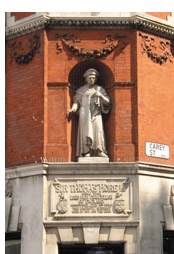
The inset photographs are of London’s Carey Street Bankruptcy Court, located in the Sir Thomas More Building, just down the road from London’s main Royal Courts of Justice complex.  This Covent Garden web guide provides the following interesting background to the bankruptcy court and the street — once known as "Queer Street" — on which it resides:

Continue Reading Recent Comparative Bankruptcy-Related Articles of Interest Available for Downloading from SSRN

Be sure to read Bob Eisenbach’s excellent up-to-the-minute summaries (here and here) on his In the (Red) Business Bankruptcy Blog of Judge Gropper’s rulings in the Northwest Airlines bankruptcy case (recently filed plan and disclosure statement are here). 

As reported by Bob, Judge Gropper in this first opinion dated 2-26-07 required hedge funds that were members of an ad hoc committee of equity holders to disclose the most holy of grails (i.e., the specific amounts held and how much was paid for each member’s interests in the debtors), and in this second opinion dated 3-9-07 refused to let them submit this information under seal.

Bob has done a great public service by pulling together the disparate pieces of this rapidly developing story.  Thanks, Bob!


© Steve Jakubowski 2007

More "Picks of the Month" …  This post covers my picks for January 2007:
The inset photograph, of course, is of Barack Obama, the first choice of many U of C law profs for president in the upcoming election, reading not his own book, but a far better one, Doris Goodwin’s highly acclaimed "Team of Rivals: The Political Genius of Abraham Lincoln."

Continue Reading Picks of the Month: Required Bankruptcy Reading for January 2007

As noted in my brief post of last week, the US Supreme Court held in a 5-4 decision in Marrama v. Citizens Bank of Massachusetts, No. 05-996 (2/21/07) (pdf / WL) that chapter 7 debtors do not have an absolute right to convert their cases to chapter 13.  So much for the broad consensus for which Justice Roberts is striving.  Not surprisingly, it was Justice Kennedy who cast the deciding swing vote.

Don’t throw away the opinion as a useless bit of trivia rarely applicable in practice, though, for the opposing views of the majority and the dissent regarding the scope of the bankruptcy court’s general and equitable powers – a subject that has generated significant academic debate – provide significant food for thought.

By way of background, be sure to read the 2005 article at 79 Am. Bankr. L. J. 1 entitled, The Limited Scope of Implied Powers of a Bankruptcy Judge:  A Statutory Court of Bankruptcy, Not a Court of Equity, where Judge Alan M. Ahart of the Bankruptcy Court for the Central District of California (who was the bankruptcy judge in this messy affair before Judge Real took hold of the reins) argues that the repeal in 1984 of 28 U.S.C. § 1481 stemming from the Supreme Court’s Marathon decision divested the non-Article III bankruptcy courts of equitable powers not specifically granted by statute.  To Judge Ahart,

[t]he only situation in which a bankruptcy judge might be compelled to rely on inherent powers is in the functioning of the court itself.  She must have authority to uphold the dignity and integrity of the judicial process.

Would Judge Ahart agree with the majority’s extension of the bankruptcy court’s "inherent power" to sanction "abusive litigation practices" and thereby enable in this case "a prompt, rather than a delayed, ruling on an unmeritorious attempt to qualify as a debtor under Chapter 13"?  Op. at p. 10 (citing Roadway Express, Inc. v. Piper, 447 U.S. 752, 765, 100 S.Ct. 2455, 65 L.Ed.2d 488 (1980)).  Or would Judge Ahart adopt the narrower views of the dissent, which concluded that "a bankruptcy court’s inherent powers may have a role to play in a case such as this, … [b]ut whatever steps a bankruptcy court may take pursuant to … its general equitable powers, a bankruptcy court cannot contravene the provisions of the Code"?  Dissent at pp. 7-9 (citing Norwest Bank Worthington v. Ahlers, 485 U.S. 197, 206 (1988)). 

Regardless, both the majority and dissent confirm Judge Ahart’s view that a bankruptcy court’s inherent powers remain extant at least where necessary to "uphold the dignity and integrity of the judicial process."  (Ahart at p. 6.)  It is the dissent’s unwillingness to use a bankruptcy court’s inherent equitable powers to override a debtor’s apparent absolute right to convert in § 706(a) that distinguishes its view from that of the majority.

Even more significant, however, is the Court’s discussion of the breadth and scope of § 105(a).  In summarizing § 105(a)’s function, Justice Stevens wrote on behalf of the majority:

[T]he broad authority granted to bankruptcy judges to take any action that is necessary or appropriate “to prevent an abuse of process” described in § 105(a) of the Code is surely adequate to authorize an immediate denial of a motion to convert filed under § 706 in lieu of a conversion order that merely postpones the allowance of equivalent relief and may provide a debtor with an opportunity to take action prejudicial to creditors.

Curiously, the second sentence of § 105(a) upon which the majority relies does not on its face provide the blanket affirmative grant of authority suggested by the majority.  Rather, this second sentence provides:

No provision of his title providing for the raising of an issue by a party in interest shall be construed to preclude the court from, sua sponte, taking any action or making any determination necessary or appropriate to enforce or implement court orders or rules, or to prevent an abuse of process.  (Emphasis added.)

A plain reading of the second sentence of § 105(a) suggests that the bankruptcy court’s power to fashion relief "necessary or appropriate … to prevent an abuse of process" is not unbounded, as suggested by the majority, but limited to instances where the Code or rules permit a particular issue to be raised by a party in interest.  In other words, to prevent an abuse of process, the court can sua sponte summarily take "necessary or appropriate" action to shut down a party in interest notwithstanding a provision in the Code that preserves within that party the right to be heard on the issue.  In effect, the majority read this qualification right out of the Code when it stated:

On the contrary, the broad authority granted to bankruptcy judges to take any action that is necessary or appropriate [**note the missing qualification here**] "to prevent an abuse of process" described in § 105(a) of the Code, is surely adequate to authorize an immediate denial of a motion to convert filed under § 706 in lieu of a conversion order that merely postpones the allowance of equivalent relief and may provide a debtor with an opportunity to take action prejudicial to creditors.  (Op. at pp. 9-10.)

As the following exchange indicates, Chief Justice Roberts seized upon this issue at oral argument, bringing it to a head before respondent’s counsel, Bingham McCutchen’s Eric Brunstad, had even finished just the third short sentence of his opening statement to the Court:

Continue Reading 5-4 US Supreme Court Majority Extends a Bankruptcy Court’s Power to Curtail a “Bad Faith” Debtor’s Seemingly Absolute Rights Under the Code

The following BAPCPA-related papers, arranged by abstract ID number, can be downloaded from the Social Science Research Network:

Federal Reserve Bank’s Astrid Andrea Dick and Andreas Lehnert: "Personal Bankruptcy and Credit Market Competition" (Abstract ID: 957778)

***

Santa Clara Univ. School of Law’s Gary Neustadter: "Yellow Pages and Web Site Advertising By Consumer Bankruptcy Attorneys After BAPCPA" (Abstract ID: 957893)

***   

Cardozo Law School’s David Gray Carlson: "Means Testing: The Failed Bankruptcy Revolution of 2005" (Abstract ID:956158)

***

Univ. of Mary Washington’s Bradley Hansen and American University’s Mary Hansen: "Legal Rules and Bankruptcy Rates: Historical Evidence from the States" (Abstract ID: 954393)

***  

Univ. of Illinois College of Law’s Robert M. Lawless and Harvard Law School’s Elizabeth Warren: "Shrinking the Safety Net: The 2005 Changes in U.S. Bankruptcy Law" (Abstract ID: 949629)

***

Univ. of Arizona College of Law’s Jean Braucher: "The Challenge to the Bench and Bar Presented by the 2005 Bankruptcy Act: Resistance Need Not be Futile" (Abstract ID: 947930)

***

UC San Diego’s Michelle J. White: "Abuse or Protection?" (Abstract ID: 944916)

***

Adam Levitin: "Priceless? The Costs of Credit Card Merchant Restraints" (Abstract ID: 944278)

***

Univ. of Illinois College of Law’s Robert M. Lawless: "The Relationship Between Nonbusiness Bankruptcy Filings and Various Measure of Consumer Debt" (Abstract ID: 934798)

***

UT Austin School of Law’s Ronald J. Mann: "Credit Card Policy in a Globalized World" (Abstract ID: 705141)

***

FYI, the graph is taken from a July 2006 Bulletin of the Federal Reserve Board, under the subheading entitled, The New Bankruptcy Law and Its Effect on Credit Card Loans.

***

Abstracts for each of these papers follows:

Continue Reading Recent BAPCPA-Related Articles of Interest Available for Downloading from SSRN

As discussed here, the US Supreme Court last term surprised many by deciding that the "plain meaning" of a bankruptcy statute must be filtered through a prism that, "in the main, secure[s] equal distribution among creditors [and] take[s] into account, as well, the complementary principle that preferential treatment of a class of creditors is in order only when clearly authorized by Congress."

Yesterday, as summarized in this post by Scott Riddle at the Georgia Bankruptcy Blog, the US Supreme Court ruled that provisions of the Bankruptcy Code that seemingly provide a debtor with an absolute right to do something (i.e., convert its case from chapter 7 to chapter 13) should be filtered through a lens that screens for the absence of "bad faith."  Marrama v. Citizens Bank of Massachusetts, No. 05-996 (2/21/07) (pdf/WL) (previewed here).

The decision isn’t surprising given bankruptcy’s equitable roots and the lack of sympathy one can muster for a "bad faith" debtor like Marrama.  More on the case later, as today I’m delivering the following two presentations for this scheduled event at the Licensing Executive Society Winter 2007 Meeting in San Francisco, and thus have neither the time nor the background briefs and transcripts at hand to provide much more insight into the case:

  • IP Licensing & BankruptcyAn Issue Spotting Checklist for Analyzing Questions Regarding Assumption, Rejection, and/or Assignment of IP Licenses in Bankruptcy

                –   and  –

Those wanting an insightful and controversial early look at the case, be sure to check out Professor Todd Zywicki’s lengthy post at the Volokh Conspiracy.

2/27/07 UpdateHere’s my follow up post on the Marrama decision, entitled 5-4 US Supreme Court Majority Extends a Bankruptcy Court’s Power to Curtail a "Bad Faith" Debtor’s Seemingly Absolute Rights Under the Code.

© Steve Jakubowski 2007