BAPCPA’s least appreciated (and understood) changes, despite their enormous impact on financial markets generally, are the changes designed to strengthen and clarify the enforceability of various types of financial derivatives contracts.  To provide enhanced protection to the financial services industry, Congress added or expanded the Code’s definitions for such industry staples as "forward contracts" (§101(25)), "repurchase agreements" (§101(47)), and "swap agreements" (§101(53B)).  Various other Code provisions were amended or added to reflect Congress’s desire to enable a nondebtor party–without hesitation–to terminate, liquidate or accelerate its securities contracts, commodity contracts, forward contracts, repurchase agreements, swap agreements or master netting agreements with the debtor.  (See generally, these few pages of professor, lawyer, Code co-architect, and energy healer Ken Klee’s excellent summary of BAPCPA’s amendments to the Code’s business-related provisions).

Columbia Law professor Edward Morrison, with Columbia GSB economics legend Franklin Edwards, argue in a Winter 2005 article entitled Derivatives and the Bankruptcy Code: Why the Special Treatment? that BAPCPA’s extension of the Code’s protections for the financial services industry "to include a broader array of financial contracts, all in the name of reducing systemic risk … is a mistake."  Rather, they argue, "[a] better, efficiency-based reason for treating derivatives contracts differently arises naturally from the economic theory underlying the automatic stay [i.e., derivative contracts are rarely needed to preserve a firm’s going-concern surplus]."  Still, they warn (at p.1):

There are, however, downsides to treating derivatives contracts differently (creditors, for example, would like to disguise loans as derivatives contracts).  These downsides are probably not signficant, but they highlight the fragility of the Code’s treatment of derivatives contracts, which should worry members of Congress as they consider arguments to expand the Code’s exemptions for derivatives contracts.

After BAPCPA became law, Professor Morrison teamed with Columbia LLM candidate (and now Davis Polk associate) Joerg Riegel to author another article entitled Financial Contracts and the New Bankruptcy Code: Insulating Markets from Bankrupt Debtors and Bankruptcy Judges.  They wrote that BAPCPA did not just "eliminate longstanding uncertainty surrounding the protections available to financial contract counterparties, especially counterparties to repurchase transactions and other derivatives contracts"  Rather, they observed, "the ambit of the reforms is much broader," especially because of the newly expanded definition of "swap agreement," which they termed "so broad that nearly every derivative contract is subject to the Code’s protection."  (p.1).  Notably, however, this conclusion was later called into question (though not expressly) by Thompson & Knight’s Rhett Campbell in a 2005 article entitled Financial Markets Contracts and BAPCPA.  He wrote that "even though the definitions themselves are often nothing more than a listing of labels with little attempt at a functional definition, the legislative history shows an intent to prevent parties from obtaining the benefits of financial contracts safe harbors merely by the judicious use of labels."  79 Am. Bankr. L. J. 697, 705 (2005).

In commenting on the impact of these reforms on the bankruptcy judiciary, Morrison and Riegel concluded (pp. 4-5):

Equally important, the amendments limit judicial discretion to assess the economic substance of financial transactions, even those that resemble ordinary loans or that retire a debtor’s outstanding debt or equity.  The reforms of 2005 direct judges to apply a formalistic inquiry based on industry custom: a financial transaction is a "swap," "repurchase transaction," or other protected transaction if it is treated as such in the relevant financial market…. 

Indeed, if anything is clear from the new Code, it is that judges are strongly discouraged from engaging in functional analysis of financial contracts.  The Code’s protections encompass contracts or combinations of contracts that differ little in substance from unprotected transactions, such as secured loans.  They are protected because they are recognized in financial markets as financial contracts.  Any judicial effort to distinguish protected and unprotected contracts based on their "substance" is doomed to failure and can only generate significant uncertainty in the very markets the Code seeks to protect.  By relying on broad market definitions, the Act gets judges out of the (largely futile) business of second-guessing financial contracts.  Absent evidence of intent to defraud a debtor’s creditors, which remains ground for denying protection to payments under a financial contract, the new role of judges is to apply industry custom to financial contracts in much the same way that they would apply custom to interpret a contract under the Uniform Commercial Code.

Maybe it’s just Professor Morrison’s year of clerking for Justice Scalia that has jaded him, but most bankruptcy judges I know don’t "apply a formalistic inquiry," especially when it comes to interpreting BAPCPA!  (See also, the opinions of Judge Bruce A. Markell (here and here) and the 60 pages of handouts on principles of statutory construction that the Southern District of Ohio’s Chief Bankruptcy Judge, Thomas F. Waldron, penned for last year’s NCBJ confab).  In this regard, it’s worth considering the words of the Eastern District of North Carolina’s Chief Bankruptcy Judge A. Thomas Small in In re Donald, 343 B.R. 524 (Bankr. E.D.N.C. 2006) (pdf), where he had this to say about interpreting BAPCPA:

Unfortunately, the BAPCPA amendments … are confusing, overlapping, and sometimes self-contradictory.  They introduce new and undefined terms that resemble, but are different from, established terms that are well understood.  Furthermore, the new provisions address some situations that are unlikely to arise.  Deciphering this puzzle is like trying to solve a Rubik’s Cube that arrived with a manufacturer’s defect.  [Ed. Note:  This one is sure to work.]  Fortunately, after many twists and turns, a few patches of solid color emerge.  Id. at 529.

Judge Small’s opinion last week in Hutson v. Smithfield Packing Co. (In re Nat’l Gas Distributors, LLC), 2007 WL 1531616 (Bankr. E.D.N.C. 5/24/07) (pdf) partially resolved BAPCPA’s puzzle regarding the scope of the "swap agreement" amendments to the Code surprisingly easily, but not because he "appl[ied] a formalistic inquiry."  Rather, in deciding whether BAPCPA’s expanded definition of "swap agreement" to include "forward agreements" would preempt an avoidance action against a nondebtor customer who received natural gas from the debtor under a below-market commodity contract, Judge Small concluded:

Continue Reading Judge Small Rules That Ordinary Commodity Supply Contracts Are Not “Swap Agreements” Under BAPCPA

Time to catch up on more "Picks of the Month."  These picks are for April 2007:

Bankruptcy veterans (and Tennesseeans) will recognize the inset photo of the Bankruptcy Court for the Middle District of Tennessee, located in the famed U.S. Customs House in Nashville, Tennessee.  President Rutherford B. Hayes laid the cornerstone to the building in 1877 on the purported first visit of a president to the South since the Civil War.  According to this story, the building represented "something of a payoff for Southern support in Hayes’ bid for the presidency [and was] evidence that he was living up to his promises, because it was the first such federal building in the former Confederate states."

The court is presently home to the district’s chief bankruptcy judge, the Hon. George C. Paine, II, and to Judges Keith M. Lundin (famed BAPCPA basher and author of a 2005 article entitled "Ten Principles of BAPCPA:  Not What Was Advertised") and Marian F. Harrison (who is overseeing this political hot potato involving Sen. Hillary Rodham Clinton and her brother Tony).

***

Continue Reading Picks of the Month: Required Bankruptcy Reading for April 2007

The following bankruptcy business-related scholarly papers, arranged by SSRN abstract ID number, can be downloaded from the Social Science Research Network website:

***

Univ. of Chicago Law School’s Douglas G. Baird, IMD International’s Arturo Bris, and Yale School of Management’s Ning Zhu, "The Dynamics of Large and Small Chapter 11 Cases: an Empirical Study" (Abstract ID:  866865)

***

Vanderbilt Univ. School of Law’s Robert K. Rasmussen, "Empirically Bankrupt" (Abstract ID:  895547)

***

Harvard Law School’s Elizabeth Warren and UT Austin’s Jay Alan Westbrook, "The Dialogue between Theoretical and Empirical Scholarship" (Abstract ID:  945155)

***

Univ. of Rochester’s Greg McGlaun, "Lender Control in Chapter 11: Empirical Evidence" (Abstract ID:  961365)

***

Dartmouth College – Tuck School of Business’ B. Espen Eckbo and Karin S. Thorburn, "Automatic Bankruptcy Auctions and Fire-Sales" (Abstract ID:  963184)

***

Max Planck Institutes Wolfgang Schoen, "Balance Sheet Tests or Solvency Tests – Or Both?" (Abstract ID:  963333)

***

Univ. of Chicago Law School’s Douglas G. Baird, "Legal Approaches to Restricting Distributors to Shareholders: the Role of Fraudulent Transfer Law" (Abstract ID:  963335)

***

Univ. of Pennsylvania Law School’s David A. Skeel Jr. and George Krause-Vilmar, "Recharacterization and the Nonhindrance of Creditors" (Abstract ID:  963338)

***

LSE’s Paul L. Davies, "Directors’ Creditor-Regarding Duties in Respect of Trading Decisions Taken in the Vicinity of Insolvency" (Abstract ID:  963340)

***

Jeffrey D. Van Niel and Nancy B. Rapoport, "’Retail Choice is Coming: Have you Hugged Your Utilities Lawyer Today? (Part 1)" (Abstract ID:  963912)

***

Jeffrey D. Van Niel and Nancy B. Rapoport: "’Retail Choice is Coming: Have you Hugged Your Utilities Lawyer Today? (Part 1)" (Abstract ID:  963913)

***

Seton Hall University School of Law’s Stephen Lubben, "Business Liquidation" (Abstract ID:  964214)

***

Georgetown University Law Center’s J. Gregory Sidak and the Kellogg School of Management’s Daniel F. Spulber, "The Tragedy of Telecoms: Government Pricing of Unbundled Network Elements Under the Telecommunications Act of 1996" (Abstract ID:  964703)

***

Georgetown University Law Center’s J. Gregory Sidak, "Why Did the U.S. Telecommunications Industry Collapse?" (Abstract ID:  964776)

***

Sabanci University’s Mine H. Akso, "Going Concern Value Versus Abandonment Option Value in Debt Restructuring Firms" (Abstract ID:  965226)

***

Univ. of Chicago’s Thomas Chaney, INSEE’s David Sraer, and HEC’s David Thesmar, "The Corporate Wealth Effect: From Real Estate Shocks to Corporate Investment" (Abstract ID:  965762)

***

Indiana University School of Law’s Kenneth Glenn Dau-Schmidt, "The Changing Face of Collective Representation: The Future of Collective Bargaining" (Abstract ID:  967454)

***

Florida State University College of Law’s Kelli A. Alces, "Enforcing Corporate Fiduciary Duties in Bankruptcy" (Abstract ID:  968006)

***

California State University-Northridge’s Rafael Efrat, "Minority Entrepreneurs in Bankruptcy" (Abstract ID:  972656)

***

California State University-Northridge’s Rafael Efrat, "The Tax Burden and the Propensity of Small Business Entrepreneurs to File for Bankruptcy" (Abstract ID:  976954)

***

Univ. of Virginia’s David Mordkoff, "From Bonehead to Chaos: The Demise of the Right to Strike in the Airline Industry" (Abstract ID:  977581)

***

UT Austin School of Law’s Henry T.C. Hu and Jay Lawrence Westbrook, "Abolition of the Corporate Duty to Creditors" (Abstract ID:  977582)

***

Texas Tech University’s Stuart Gilliand and Baylor University’s John D. Martin, "Corporate Governance Post-Enron: Effective Reforms, or Closing the Stable Door?" (Abstract ID:  977585)

***

UCLA School of Law’s Lynn M. LoPucki and Joseph W. Doherty, "Bankruptcy Fire Sales" (Abstract ID: 980585)

***

Vanderbilt University School of Law’s Robert K. Rasmussen, "The Story of Case v. Los Angeles Lumber Products: Old Equity Holders and the Reorganized Corporation" (Abstract ID:  980708)

***

Abstracts for each of these papers follows:

Continue Reading Recent Posted or Updated Bankruptcy Business-Related Articles of Interest Available for Downloading from SSRN

Having finally wrapped up this mess, it’s back to blogging on a more regular basis…

Yesterday, Fed Chairman Ben Bernanke commented at length for his fellow economists at the Federal Reserve Bank on how problems in the market for subprime mortgages may affect the housing markets and the economy generally.  As one of my favorite economist bloggers summed up in this post at the Calculated Risk blog, according to Chairman Bernanke, "everything will be fine."

That may be reassuring to stock market investors, who must be feeling a bit dizzy from the recent 15% run up since the subprime collapse took its toll on the market a few months back.  For those left holding the bag, however, there’s little solace to be drawn from Chairman Bernanke’s comments.  But, based on the benefits Chairman Bernanke noted the subprime shakeout is having on helping rein in loose lending practices generally, I think it’s fair to say here that one man’s noose is another man’s whip.

For those purchasers of securitized subprime mortgage-backed securities left holding the bag, however, there is one prayer that may provide much needed relief … and that’s the "prayer for relief" that accompanies a complaint filed in the US district court.  As this 8-count complaint proves, there’s no shortage of prayers for relief available to the disgruntled investor left holding the bag.   Bankers Life Insurance Co. v. Credit Suisse First Boston Corp., et. al., No. 07-690 (M.D. Fla. 4/23/07) (hat tip: Calculated Risk). 

Through its complaint, Bankers Life seeks to recover the 95% of its $1.4 million investment that it lost when it purchased in 2004 certain securitized mortgage-backed loans that were originally issued in 2001 in an offering underwritten by Credit Suisse First Boston and DLJ Mortgage Capital.  The packaged loans were subsequently serviced by Select Portfolio Servicing (SPS) of Salt Lake City. 

Cutting to the chase, Bankers Life alleges that CFSB, DLJ, and SPS misled the agencies whose ratings determined the market price of the securitiies by misrepresenting key indicators relating to the portfolio’s performance.  As a result, the complaint alleges, Bankers Life was left holding the bag since it paid about $1.3 million more than the securities were inherently worth.

As every litigator knows, alleging something is one thing, but proving and recovering on it is a "horse of a different color," as the old saying goes.  Here are a few "off the cuff" thoughts as to why I think this complaint will have difficulty surviving a motion to dismiss….

Continue Reading The Subprime Lending Shakeout: A Litigation Perspective

To me, the greatest benefit of blogging is that it has enabled me to meet and befriend so many in the profession (lawyers, judges, and professionals alike) whom I otherwise likely would never have even met. 

Cathy Vance, Vice President of Research & Policy and Associate General Counsel of Development Specialists, Inc. (DSI), is one such person. 

During BAPCPA’s most formative and tumultuous years, starting in 1998, Cathy viewed BAPCPA’s development from the unique vantage point of legal writer, analyst, and national education coordinator for the Commercial Law League of America

She has penned numerous articles on BAPCPA, and even published (with Corrine Cooper) a "best-selling" book (hey, #542,995 ranking on Amazon is actually high for a bankruptcy treatise!), which I reviewed briefly in this post of one year ago

In the book’s preface, Cathy and her co-author open with the following thought:

We spent much of our time during the period from 2000 to March 2005 fighting the passage of the Bankruptcy Reform Act.  We wish it had not passed.  It is terrible legislation for a whole variety of reasons.

The remaining 350+ pages of the book prove their point!

Cathy is here in Chicago attending the 77th annual spring meeting of the Commercial Law League of America, fresh from her television debut last week on C-Span, which broadcast live on 4/13 the "Bankruptcy Roundtable discussion" at the ABI Spring Meeting (which featured an all-star panel that included Cathy, DSI’s head honcho Bill Brandt, Illinois Senator Dick Durbin, Jefferies & Co.’s Bill Derrough, Cliff White, Acting Director of the Executive Office for US Trustees, and Travis Plunkett of the Consumer Federation of America).

Cathy, a BAPCPA guru if ever there was one, has graciously agreed (in what I hope will be an annual undertaking!) to post a few "happy" birthday thoughts and reflections on this, the 2d anniversary of BAPCPA’s enactment, regarding some of the surprising results culled from a recently completed survey sponsored by the CLLA.

So without further ado, heeeeeeerrrrrreeee’s Cathy! ……..

Continue Reading As BAPCPA Enters Its “Terrible Two’s,” BAPCPA Guru Catherine Vance Surveys Its Unruly Landscape

As reported in my prior post last January, Judge Shira A. Scheindlin of the United States District Court for the Southern District of New York issued a ruling on January 24, 2007 that she called "one of the most difficult tasks this Court has yet confronted."  In it, by entering a stay of confirmation conditioned upon the posting of a $1.3 billion bond, she nearly derailed plan confirmation in the Adelphia bankruptcy, which Judge Robert Gerber, the presiding bankruptcy judge, called "among the most challenging — and contentious — in bankruptcy history."

By way of comparison, Judge Scheindlin’s ruling last week that pulled the plug on the dissident bondholders’ appeal seemed "a piece of cake."   Why the change of heart?  Judge Scheindlin realized, as she put it, that the bondholders "used the Court to obtain bargaining leverage to extract a better deal for their client with no intention of ever posting a reasonable bond."  "[Their] inconsistent positions," she found, "have had an impact on judicial integrity and have prejudiced Appellees."  "Such behavior," she observed, "is cynical at best and unprincipled at worst."  ACC Bondholder Group v. Adelphia Comm. Corp. (In re Adelphia Comm. Corp.), 07-1172 (S.D.N.Y. 4/2/2007) (Opinion at p.14 n.33).

By way of background as to how the case proceeded from my last post, Judge Scheindlin recounted that soon after the bondholders appealed Judge Scheindlin’s initial decision, the 2d Circuit on 2/9/07 dismissed the appeal for lack of jurisdiction on the basis that bondholders were unwilling, rather than unable, to post the requisite bond.  (Op. at 4.)  The 2d Circuit, however, noted in remanding the case to Judge Scheindlin that the dissident bondholder group could

seek modification of the bond amount (a) if it can show that it is in fact unable (rather than unwilling) to post the required amount or (b) to present alternative arrangements for the District Court’s consideration that might lessen the amount of harm likely to be suffered by the Appellees in the event of an unsuccessful appeal, thereby perhaps justifying a reduction in the amount of the bond.  (Op. at 4.)

Because the bondholders would not budge from the $10 million bond amount originally proposed, however, Judge Scheindlin vacated the stay on 2/12/07, finding that "such a small bond was unacceptable to the Court in light of the magnitude of threatened harm to the Appellees."  (Op. at 5.) 

Once the stay was lifted, Adelphia wasted no time in consummating the plan, distributing $6.49 billion in cash to 8,000 claimants, 118 million shares of free trading Time Warner Cable stock to 13,500 claimants, and 9.56 billion freely tradable interests in the "Contingent Value Vehicle" (a post-confirmation litigation trust) to 8,000 claimants and 23,000 equity interest holders.   (Op. at 5-6.)

In the end, the bondholders’ lost in part because they were so persuasive in the first round before Judge Scheindlin where they argued that if Adelphia were permitted to consummate the plan, then the appeal would be "equitably mooted."  This earlier argument, the Court held, precluded them under the principles of judicial estoppel from arguing the opposite view — in this second bite at the apple — that consummation of the plan would not equitably moot their appeal.  (Op. at 11-14.)

Regardless, Judge Scheindlin held, the appeal in fact was equitably mooted by the plan’s substantial consummation because the bondholders "fail[ed] to meet their burden on four of the five Chateaugay factors" that would support hearing the merits of their appeal.  (Op. at 14-15) (citing Frito-Lay, Inc. v. LTV Steel Co. (In re Chateaugay Corp.), 10 F.3d 944, 952 (2d Cir. 1993) (these four factors being (i) whether effective relief can be granted (Op. at 15-20); (ii) whether such relief will unravel intricate transactions (Op. at 21-22); (iii) whether parties adversely affected have had notice and opportunity to participate in the appeal (Op. at 22-25); and (iv) whether appellants pursued a stay with diligence (Op. at 25-26)).

Judge Scheindlin closed the opinion by yet again expressing her displeasure with the bondholders for "pursuing a stay that they never intended to bond," once more demonstrating that a party attempting to "stop the confirmation train from leaving the station" better be prepared to "put up or shut up," as the old saying goes.

© Steve Jakubowski 2007

The following bankruptcy-related scholarly papers, arranged by SSRN abstract ID number, can be downloaded from the Social Science Research Network website:
***


Boalt Hall School of Law’s Peter S. Menell: Bankruptcy Treatment of Intellectual Property Assets: an Economic Analysis (Abstract ID: 969521)

***

Florida State Univ. College of Law’s Kelli A. Alces: "Enforcing Corporate Fiduciary Duties in Bankruptcy." (Abstract ID: 968006)

***

Seton Hall Univ. School of Laws Stephen Lubben: "Delaware’s Irrelevance" (Abstract ID: 967892)

***

George Mason Univ. School of Law’s David E. Bernstein, "Expert Witnesses, Adversarial Bias, and the (Partial) Failure of the Daubert Revolution" (Abstract ID: 963461)

***

U.S. DOJ’s Gregory J. Werden: "The Admissibility of Expert Economic Testimony in Antitrust Cases" (Abstract ID: 956397)

***

Michael Nwogugu: "Constitutionality of US Bankruptcy Code Preemption of Mortgage Foreclosure Statutes, and Related Economic Effects" (Abstract ID: 955914)

***

NYU School of Law’s Barry E. Adler: "The Questionable Axiom of Butner v. United States" (Abstract ID: 954153)

***

Loyola Univ. of Chicago’s Spencer Weber Waller and Brooklyn Law School’s Neil B. Cohen: "Taking Pops Ups Seriously: The Jurisprudence of the Infield Fly Rule" (Abstract ID: 949539

***

Univ. of Houston Law Center’s Nancy B. Rapoport: "Avoiding Judicial Wrath: The Ten Commandments for Bankruptcy Practitioners" (Abstract ID: 940769

***

Washington and Lee University School of Law’s Doug Rendleman: "A Cap on the Defendant’s Appeal Bond?: Punitive Damages Tort Reform" (Abstract ID: 938784)

***

Univ. of Houston Law Center’s Nancy B. Rapoport: "The Need for New Bankruptcy Ethics Rules: How Can ‘One Size Fit All’ Fit Anybody?" (Abstract ID: 939448

***

Abstracts for each of these papers follows:

Continue Reading Recent Bankruptcy-Related Articles of Interest Available for Downloading from SSRN

The following bankruptcy finance-related working papers, arranged by abstract ID number, can be downloaded from the Social Science Research Network:

***

Santa Clara University’s Yongtae Kim and Oklahoma State University’s Sandeep Nabar: "Bankruptcy Probability Changes and the Differential informativeness of Bond Upgrades and Downgrades" (Abstract ID: 960751)

***

Univ. of Minnesota’s Paul Pover and Rakdeep Singh: "Sale-Backs in Bankruptcy" (Abstract ID: 956211):

***

NYU School of Law’s (and former classmate) Barry E. Adler: "Game-Theoretic Bankruptcy Valuation" (Abstract ID: 954147)

***

Univ. of Westminster’s John Flood: "The Vultures Fly East: The Creation and Globalization of the Distressed Debt Market" (Abstract ID: 949581)

*** 

Univ. of Arizona’s Andrew Zhang: "Distress Risk Premia in Stock and Bond Returns" (Abstract ID: 947844)

***

Rice University’s Evgeny Lyandres and George Mason University’s Alexei Zhdanov: "Investment Opportunities and Bankruptcy Prediction" (Abstract ID: 946240)

***

Univ. of Minnesota’s Timothy J. Kehoe and UCLA’s David K. Levine: "Bankruptcy and Collateral in Debt Constrained Markets" (Abstract ID: 940605)

***

Univ. of Verona’s Andrea Gamba and Daniele Poiega; Univ. of Navarra’s Mamen Aranda: "Investment and Credit Risk: A Structural Approach" (Abstract ID: 945968) 

***

Univ. of Chicago’s Arthur G. Korteweg: "The Costs of Financial Distress across Industries" (Abstract ID: 945425

***

UC San Diego’s Michelle J. Waite: "Abuse or Protection?" (Abstract ID: 944916)

***

NYU’s Edward I. Altman and Brent Pasternack: "Defaults and Returns in the High Yield Bond Market: The Year 2005 in Review and Market Outlook" (Abstract ID: 943326)

***

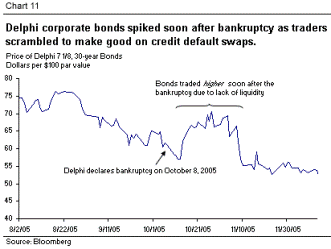
The inset graph is taken from a report to the FDIC Board of Directors dated May 9, 2006, entitled Economic Conditions and Emerging Risks in Banking, and is used to support the following point:

Improvement of the credit default settlement process is vital. Because of the growth in credit derivative contracts, market anomalies have occurred when corporations default or declare bankruptcy. A prime example is how corporate bonds of Delphi Corp. actually increased in value as traders bid up the price of bonds in order to physically settle credit derivative contracts.  Industry participants are committed to implementing new procedures for settlements following a credit event, providing for net cash settlement at a single auction-based price.

***

Abstracts for each of these papers follow:

Continue Reading Recent Bankruptcy Finance-Related Articles of Interest Available for Downloading from SSRN