 Time to catch up on the ever-popular "Picks of the Month." These picks are for February 2007.
***
Continue Reading Picks of the Month: Required Bankruptcy Reading for February 2007
Time to catch up on the ever-popular "Picks of the Month." These picks are for February 2007.
***
Continue Reading Picks of the Month: Required Bankruptcy Reading for February 2007
 To me, the greatest benefit of blogging is that it has enabled me to meet and befriend so many in the profession (lawyers, judges, and professionals alike) whom I otherwise likely would never have even met.
Cathy Vance, Vice President of Research & Policy and Associate General Counsel of Development Specialists, Inc. (DSI), is one such person.
During BAPCPA’s most formative and tumultuous years, starting in 1998, Cathy viewed BAPCPA’s development from the unique vantage point of legal writer, analyst, and national education coordinator for the Commercial Law League of America.
She has penned numerous articles on BAPCPA, and even published (with Corrine Cooper) a "best-selling" book (hey, #542,995 ranking on Amazon is actually high for a bankruptcy treatise!), which I reviewed briefly in this post of one year ago.
In the book’s preface, Cathy and her co-author open with the following thought:
We spent much of our time during the period from 2000 to March 2005 fighting the passage of the Bankruptcy Reform Act. We wish it had not passed. It is terrible legislation for a whole variety of reasons.
The remaining 350+ pages of the book prove their point!
Cathy is here in Chicago attending the 77th annual spring meeting of the Commercial Law League of America, fresh from her television debut last week on C-Span, which broadcast live on 4/13 the "Bankruptcy Roundtable discussion" at the ABI Spring Meeting (which featured an all-star panel that included Cathy, DSI’s head honcho Bill Brandt, Illinois Senator Dick Durbin, Jefferies & Co.’s Bill Derrough, Cliff White, Acting Director of the Executive Office for US Trustees, and Travis Plunkett of the Consumer Federation of America).
Cathy, a BAPCPA guru if ever there was one, has graciously agreed (in what I hope will be an annual undertaking!) to post a few "happy" birthday thoughts and reflections on this, the 2d anniversary of BAPCPA’s enactment, regarding some of the surprising results culled from a recently completed survey sponsored by the CLLA.
So without further ado, heeeeeeerrrrrreeee’s Cathy! ……..
 As reported in my prior post last January, Judge Shira A. Scheindlin of the United States District Court for the Southern District of New York issued a ruling on January 24, 2007 that she called "one of the most difficult tasks this Court has yet confronted." In it, by entering a stay of confirmation conditioned upon the posting of a $1.3 billion bond, she nearly derailed plan confirmation in the Adelphia bankruptcy, which Judge Robert Gerber, the presiding bankruptcy judge, called "among the most challenging — and contentious — in bankruptcy history."
By way of comparison, Judge Scheindlin’s ruling last week that pulled the plug on the dissident bondholders’ appeal seemed "a piece of cake." Why the change of heart? Judge Scheindlin realized, as she put it, that the bondholders "used the Court to obtain bargaining leverage to extract a better deal for their client with no intention of ever posting a reasonable bond." "[Their] inconsistent positions," she found, "have had an impact on judicial integrity and have prejudiced Appellees." "Such behavior," she observed, "is cynical at best and unprincipled at worst." ACC Bondholder Group v. Adelphia Comm. Corp. (In re Adelphia Comm. Corp.), 07-1172 (S.D.N.Y. 4/2/2007) (Opinion at p.14 n.33).
By way of background as to how the case proceeded from my last post, Judge Scheindlin recounted that soon after the bondholders appealed Judge Scheindlin’s initial decision, the 2d Circuit on 2/9/07 dismissed the appeal for lack of jurisdiction on the basis that bondholders were unwilling, rather than unable, to post the requisite bond. (Op. at 4.) The 2d Circuit, however, noted in remanding the case to Judge Scheindlin that the dissident bondholder group could
seek modification of the bond amount (a) if it can show that it is in fact unable (rather than unwilling) to post the required amount or (b) to present alternative arrangements for the District Court’s consideration that might lessen the amount of harm likely to be suffered by the Appellees in the event of an unsuccessful appeal, thereby perhaps justifying a reduction in the amount of the bond. (Op. at 4.)
Because the bondholders would not budge from the $10 million bond amount originally proposed, however, Judge Scheindlin vacated the stay on 2/12/07, finding that "such a small bond was unacceptable to the Court in light of the magnitude of threatened harm to the Appellees." (Op. at 5.)
Once the stay was lifted, Adelphia wasted no time in consummating the plan, distributing $6.49 billion in cash to 8,000 claimants, 118 million shares of free trading Time Warner Cable stock to 13,500 claimants, and 9.56 billion freely tradable interests in the "Contingent Value Vehicle" (a post-confirmation litigation trust) to 8,000 claimants and 23,000 equity interest holders. (Op. at 5-6.)
In the end, the bondholders’ lost in part because they were so persuasive in the first round before Judge Scheindlin where they argued that if Adelphia were permitted to consummate the plan, then the appeal would be "equitably mooted." This earlier argument, the Court held, precluded them under the principles of judicial estoppel from arguing the opposite view — in this second bite at the apple — that consummation of the plan would not equitably moot their appeal. (Op. at 11-14.)
Regardless, Judge Scheindlin held, the appeal in fact was equitably mooted by the plan’s substantial consummation because the bondholders "fail[ed] to meet their burden on four of the five Chateaugay factors" that would support hearing the merits of their appeal. (Op. at 14-15) (citing Frito-Lay, Inc. v. LTV Steel Co. (In re Chateaugay Corp.), 10 F.3d 944, 952 (2d Cir. 1993) (these four factors being (i) whether effective relief can be granted (Op. at 15-20); (ii) whether such relief will unravel intricate transactions (Op. at 21-22); (iii) whether parties adversely affected have had notice and opportunity to participate in the appeal (Op. at 22-25); and (iv) whether appellants pursued a stay with diligence (Op. at 25-26)).
Judge Scheindlin closed the opinion by yet again expressing her displeasure with the bondholders for "pursuing a stay that they never intended to bond," once more demonstrating that a party attempting to "stop the confirmation train from leaving the station" better be prepared to "put up or shut up," as the old saying goes.
© Steve Jakubowski 2007
 The following bankruptcy-related scholarly papers, arranged by SSRN abstract ID number, can be downloaded from the Social Science Research Network website:
***
Boalt Hall School of Law’s Peter S. Menell: Bankruptcy Treatment of Intellectual Property Assets: an Economic Analysis (Abstract ID: 969521)
***
Florida State Univ. College of Law’s Kelli A. Alces: "Enforcing Corporate Fiduciary Duties in Bankruptcy." (Abstract ID: 968006)
***
Seton Hall Univ. School of Laws Stephen Lubben: "Delaware’s Irrelevance" (Abstract ID: 967892)
***
George Mason Univ. School of Law’s David E. Bernstein, "Expert Witnesses, Adversarial Bias, and the (Partial) Failure of the Daubert Revolution" (Abstract ID: 963461)
***
U.S. DOJ’s Gregory J. Werden: "The Admissibility of Expert Economic Testimony in Antitrust Cases" (Abstract ID: 956397)
***
Michael Nwogugu: "Constitutionality of US Bankruptcy Code Preemption of Mortgage Foreclosure Statutes, and Related Economic Effects" (Abstract ID: 955914)
***
NYU School of Law’s Barry E. Adler: "The Questionable Axiom of Butner v. United States" (Abstract ID: 954153)
***
Loyola Univ. of Chicago’s Spencer Weber Waller and Brooklyn Law School’s Neil B. Cohen: "Taking Pops Ups Seriously: The Jurisprudence of the Infield Fly Rule" (Abstract ID: 949539)
***
Univ. of Houston Law Center’s Nancy B. Rapoport: "Avoiding Judicial Wrath: The Ten Commandments for Bankruptcy Practitioners" (Abstract ID: 940769)
***
Washington and Lee University School of Law’s Doug Rendleman: "A Cap on the Defendant’s Appeal Bond?: Punitive Damages Tort Reform" (Abstract ID: 938784)
***
Univ. of Houston Law Center’s Nancy B. Rapoport: "The Need for New Bankruptcy Ethics Rules: How Can ‘One Size Fit All’ Fit Anybody?" (Abstract ID: 939448)
***
Abstracts for each of these papers follows:
Continue Reading Recent Bankruptcy-Related Articles of Interest Available for Downloading from SSRN
 The following bankruptcy finance-related working papers, arranged by abstract ID number, can be downloaded from the Social Science Research Network:
***
Santa Clara University’s Yongtae Kim and Oklahoma State University’s Sandeep Nabar: "Bankruptcy Probability Changes and the Differential informativeness of Bond Upgrades and Downgrades" (Abstract ID: 960751)
***
Univ. of Minnesota’s Paul Pover and Rakdeep Singh: "Sale-Backs in Bankruptcy" (Abstract ID: 956211):
***
NYU School of Law’s (and former classmate) Barry E. Adler: "Game-Theoretic Bankruptcy Valuation" (Abstract ID: 954147)
***
Univ. of Westminster’s John Flood: "The Vultures Fly East: The Creation and Globalization of the Distressed Debt Market" (Abstract ID: 949581)
***
Univ. of Arizona’s Andrew Zhang: "Distress Risk Premia in Stock and Bond Returns" (Abstract ID: 947844)
***
Rice University’s Evgeny Lyandres and George Mason University’s Alexei Zhdanov: "Investment Opportunities and Bankruptcy Prediction" (Abstract ID: 946240)
***
Univ. of Minnesota’s Timothy J. Kehoe and UCLA’s David K. Levine: "Bankruptcy and Collateral in Debt Constrained Markets" (Abstract ID: 940605)
***
Univ. of Verona’s Andrea Gamba and Daniele Poiega; Univ. of Navarra’s Mamen Aranda: "Investment and Credit Risk: A Structural Approach" (Abstract ID: 945968)
***
Univ. of Chicago’s Arthur G. Korteweg: "The Costs of Financial Distress across Industries" (Abstract ID: 945425)
***
UC San Diego’s Michelle J. Waite: "Abuse or Protection?" (Abstract ID: 944916)
***
NYU’s Edward I. Altman and Brent Pasternack: "Defaults and Returns in the High Yield Bond Market: The Year 2005 in Review and Market Outlook" (Abstract ID: 943326)
***
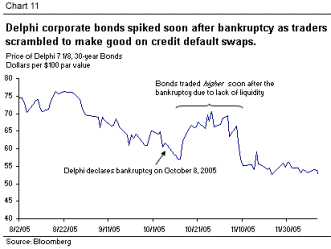
The inset graph is taken from a report to the FDIC Board of Directors dated May 9, 2006, entitled Economic Conditions and Emerging Risks in Banking, and is used to support the following point:
Improvement of the credit default settlement process is vital. Because of the growth in credit derivative contracts, market anomalies have occurred when corporations default or declare bankruptcy. A prime example is how corporate bonds of Delphi Corp. actually increased in value as traders bid up the price of bonds in order to physically settle credit derivative contracts. Industry participants are committed to implementing new procedures for settlements following a credit event, providing for net cash settlement at a single auction-based price.
***
Abstracts for each of these papers follow:
.gif) [6/18/09 Update: Those looking for my post on today’s Travelers v. Bailey decision can find it here. This post is about the 2007 decision in Travelers v. PG&E.]
[6/18/09 Update: Those looking for my post on today’s Travelers v. Bailey decision can find it here. This post is about the 2007 decision in Travelers v. PG&E.]
In arguing against cameras in the courtroom in recent testimony before the Senate, Supreme Court Justice Anthony Kennedy noted the special rules of etiquette that govern proceedings before the US Supreme Court. He said:
We have a language, and ethic and etiquette, a formality, a tradition that’s different than the political branches; not better, not worse, but different.
One of those traditions, embodied in Supreme Court Rule 14.1(a) and many, many Supreme Court cases (e.g., Hines Yellow Pine Trustees v. Martin, 268 U.S. 458, 465, 45 S. Ct. 543 (1925)), is that you don’t raise new issues for the first time in merits briefs on cases before the Court. Yet that’s exactly what PG&E did in Travelers Casualty and Surety Co. of Am. v. Pacific Gas and Elec. Co., No. 05-1429, 2007 WL 816795 (3/20/07) (pdf), and the Justices were clearly none too pleased about it. After all, certiorari had been granted for the sole purpose of resolving the conflict among the circuits regarding the validity of the 9th Circuit’s so-called “Fobian rule” (which provides that attorney fees are not recoverable in bankruptcy for litigating issues peculiar to federal bankruptcy law). (Op. at 4, 7-8.) And to make matters even worse, PG&E’s counsel admitted at oral argument that the both sides agree (though for different reasons) that the Fobian rule is wrong! (Op. at 10.)
Instead of advising the Court in its opposition to the petition for certiorari that it agreed with the petitioner that Fobian was wrong, however, PG&E raised for the first time in its merits response brief why a fair reading of the Bankruptcy Code makes Fobian right, though not for the reason upon which certiorari was granted. Chief Justice Roberts hoisted PG&E’s counsel on his own petard in calling PG&E’s tactics “an ambush and … a smuggling in the sense we don’t have a Court of Appeals decision one way or the other on that question.” (Oral Arg. Tr. at 28:1-4.) Justices Stevens and Ginsburg echoed Chief Justice Roberts’ displeasure with the following exchange (Tr. at 28:17-29:2):
Justice Stevens: Well, why then isn’t the proper disposition of this case to send it back to the Ninth Circuit to consider all these other arguments?
PG&E Counsel: Well, Your Honor, because this issue has been fully ventilated among the lower courts.
Justice Ginsburg: Yes, but we are not a court of first view and you know that very well. We are a court of review. So no matter how well it’s been aired [in other circuit cases], we wait to see what the lower courts have said on a question. We don’t take it in the first instance.
Still, the Justices made the best of the situation, and seemed genuinely interested in exploring the question of whether unsecured creditors have a right to attorneys’ fees expended postpetition. But, as explained here (Credit Slips blog), here (In the Red Business Bankr. Blog), here (SCOTUS blog), and here (Georgia Bankr. Blog) the case was an easy one to decide because there wasn’t a soul in the entire Supreme Court that day who believed that Fobian was correctly decided.
The task of drafting the opinion fell to Justice Alito, author of the Marrama dissent, who didn’t ask a single question at oral argument. His opinion is straightforward, but noteworthy for at least reminding us of several fundamental principles of law that remain in the forefront of the Supreme Court’s bankruptcy jurisprudence. They are:
Continue Reading US Supreme Court Expresses Supreme Displeasure at PG&E’s “Ambush and a Smuggling”
.jpg) A year ago, I voiced my concerns in a post entitled "The Subprime Squeeze" that the dramatic "hockey stick" growth in housing’s subprime lending market was "more likely caused by looser adherence to underwriting standards than by increased demand for subprime products among qualified borrowers." "If, in fact, looser credit standards have driven the current exponential growth since 2000 in subprime lending," I predicted, "then waves of defaults will be ‘tsunami-like’ in proportion." Last Memorial Day, I echoed these sentiments in this post.
A year ago, I voiced my concerns in a post entitled "The Subprime Squeeze" that the dramatic "hockey stick" growth in housing’s subprime lending market was "more likely caused by looser adherence to underwriting standards than by increased demand for subprime products among qualified borrowers." "If, in fact, looser credit standards have driven the current exponential growth since 2000 in subprime lending," I predicted, "then waves of defaults will be ‘tsunami-like’ in proportion." Last Memorial Day, I echoed these sentiments in this post.
Well, "the chickens are coming home to roost," as the old saying goes, and the subprime squeeze is looking to some (such as Professor Nouriel Roubini) more like a hangman’s noose.
Courtesy of the TPM Cafe Blog, here’s a great read from Credit Suisse entitled "The Impact of the 2005 Bankruptcy Law on Subprime HEL [Home Equity Loans]." Here are the conclusions of the report:
• We believe that the new bankruptcy law introduced on October 17, 2005 has had a profound impact on subprime borrowers. Under the new law, we find that bankrupt borrowers are riskier. Under the new law, the means test is more difficult to pass for bankruptcy petitioners, and more subprime mortgagor filers are required to enter Chapter 13 rather than Chapter 7 bankruptcy, even though they might not be able to complete the repayment plan. Our analysis reveals that a higher percentage of borrowers are failing their bankruptcy repayment plans.
• The stringent means test also means more delinquent loans have to go into foreclosure directly rather than into bankruptcy. Therefore, it is directly responsible for the rising foreclosure rate since the end of 2005.
• We believe that the cash flow from bankrupt filers is lower after the new law, and the cure rate from bankruptcy has declined.
• The roll rate pattern since October 2005 indicates that roll rate data prior to the bankruptcy law change should be used with caution, as it overstates the cure rate and can have a non-trivial impact on delinquency and trigger projections.
Remember the old maxim, "bad cases make bad law" (cited as a "rule" in this 1845 US Supreme Court opinion)? Well, when it comes to BAPCPA, the converse is also proving to be true, even for the hard-nosed lenders the law was designed to benefit.
I’ve discussed here and here the "law of unintended consequences" affecting subprime auto lenders as a result of BAPCPA’s "hanging paragraph." Looks like we can add the subprime home lenders to the list of those to whom BAPCPA’s "conventional wisdoms" don’t apply. Regardless, the squeeze continues.
© Steve Jakubowski 2007
 Bankruptcies may be down, but opinions sure seem to be up. Lots of interesting cases reported as of late. Here’s a few recent cases, sorted by date, that I thought you’d find of interest:
***
 The following comparative bankruptcy-related papers, arranged by abstract ID number, can be downloaded from the Social Science Research Network:
Inst. for Macroeconomic Analysis and Development’s Arjana Brezigar Masten and Univ. of Ljubljana’s Igor Masten: "Comparison of Parametric, Semi-Parametric and Non-Parametric Methods in Bankruptcy Prediction" (Abstract ID: 967637)
***
York University Law School’s Iain D.C. Ramsay: "Comparative Consumer Bankruptcy" (Abstract ID: 958190)
***
Norwegian University of Science and Technology’s Einar Matson: "New Technology-Based Firms: Their Failure Rates and Reasons for Failures." (Abstract ID: 942196)
***
Univ. of Westminster’s John Flood and Univ. of Olswang’s Eleni Skordaki: "Normative Bricolage: Informal Rule Making by Accountants and Lawyers in Mega Insolvencies." (Abstract ID: 949895)
***
World Bank Group’s Simeon Djankov and Caralee McLiesh; Harvard University’s Oliver Hart and Andrei Shleifer: "Debt Enforcement Around the World." (Abstract ID: 953000)
***
University College London’s Riz Mokal: "Contractarianism, Contractualism, and the Law of Corporate Insolvency." (Abstract ID: 946403):
***
Catholic University of Louvain’s Juan D. Moreno-Ternero: "The Proportional rule of multi-issue bankruptcy problems." (Abstract ID: 945082)
***
Univ. of Bocconi’s Pietro Garibaldi: "Hiring Freeze and Bankruptcy in Unemployment Dynamics" (Abstract ID: 928809)
***
Aachen University’s Wolfgang Breuer and Univ. of Braunschweig’s Marc Gurtler: "Coherent Banking Capital and Optimal Credit Portfolio Structure." (Abstract ID: 942742)
***
Clifford Chance LLP’s Tomas Richter: "One Flight over Czech Security: Priorities and Other Monsters of Post-Transformation Debtor/Creditor Law." (Abstract ID: 941119)
***
London Business School’s Viral V. Acharya, Univ. of Michigan’s Sreedhar T. Bharath, and National Univ. of Singapore’s Anand Srinivasan: "Does Industry-Wide Distress Affect Defaulted Firms? Evidence from Creditor Recoveries." (Abstract ID: 442901)
***
Universidad Technologica de Bolivar’s Ignacio Velez-Pareja and University of the Andes’ Patricia Rojas: "Some Evidence on Financial Distress Costs and Their Effect on Cash Flows." (Abstract ID: 939731)
***
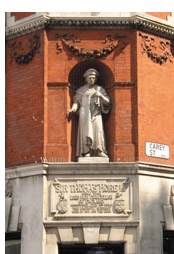
 The inset photographs are of London’s Carey Street Bankruptcy Court, located in the Sir Thomas More Building, just down the road from London’s main Royal Courts of Justice complex. This Covent Garden web guide provides the following interesting background to the bankruptcy court and the street — once known as "Queer Street" — on which it resides:
.jpg) Be sure to read Bob Eisenbach’s excellent up-to-the-minute summaries (here and here) on his In the (Red) Business Bankruptcy Blog of Judge Gropper’s rulings in the Northwest Airlines bankruptcy case (recently filed plan and disclosure statement are here).
Be sure to read Bob Eisenbach’s excellent up-to-the-minute summaries (here and here) on his In the (Red) Business Bankruptcy Blog of Judge Gropper’s rulings in the Northwest Airlines bankruptcy case (recently filed plan and disclosure statement are here).
As reported by Bob, Judge Gropper in this first opinion dated 2-26-07 required hedge funds that were members of an ad hoc committee of equity holders to disclose the most holy of grails (i.e., the specific amounts held and how much was paid for each member’s interests in the debtors), and in this second opinion dated 3-9-07 refused to let them submit this information under seal.
Bob has done a great public service by pulling together the disparate pieces of this rapidly developing story. Thanks, Bob!
© Steve Jakubowski 2007

