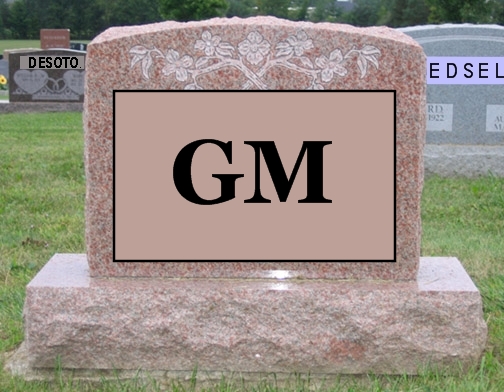
[6/9/09 UpdateSee Part II of my analysis of Judge Gonzalez’s sale opinion here.]

Well it’s official, and really no surprise:  Judge Gonzalez in this opinion (WL) approved the sale of Chrysler’s assets in the Fiat Transaction "free and clear of liens, claims, interests and encumbrances."

Part I of my quick take on the opinion focuses on the most discussed elements of the case that have caused so much unnecessary heartburn (some caused, I admit, by my own three previous posts).  Here’s my thoughts on a few of the key issues in the opinion that I touched upon in prior posts:

  • Was it a sub rosa plan (as questioned here)?  The Court said no.  And I actually agree.  It’s hard to argue something circumvents the chapter 11 plan process when the debtor wouldn’t have survived long enough to be able to propose a plan in the first place.  Arguments that a sale is a sub rosa plan make sense when the debtor can survive to confirmation; they are irrelevant where the debtor can’t.
  • Was the absolute priority rule violated (as questioned here)?  The Court danced around this issue pretty well, taking the position, well stated in this Credit Slips blog post, that "the allocation of ownership interests in the new enterprise is irrelevant to the estates’ economic interests" and that "in addition, the UAW, VEBA, and the Treasury are not receiving distributions on account of their prepetition claims … [but] under separately-negotiated agreements with New Chrysler … [that are] not value which would otherwise inure to the benefit of the Debtors’ estates." 

Everyone cares about the retirees’ medical claims under VEBA, but it’s hard to see why this group should get any consideration from the New Chrysler since they will provide no value to the new enterprise.  Moreover, it’s quite common in bankruptcy cases (see In re UAL, discussed here) for the current employees to leave the retirees hanging out to dry precisely because they’ll provide no value to the new enterprise and the existing employees want to retain whatever benefits they can eke out for themselves.  To this limited extent, therefore, perhaps the flow of consideration does violate the absolute priority rule.  The auto workers union is obviously a tighter and more cohesive group, however, and they refused to do what their comrades in the pilots union did to the retiree pilots, thus enabling the Court here to find that the "unprecedented modifications to the collective bargaining agreement, including a six-year no-strike clause" were sufficient to justify New Chrysler’s assumption of obligations to all VEBA claimants, as demanded by the union.

  • What are the rules of the game for "last-resort" lenders?  One thing I said in my 10 minute interview with Anthony Mason that didn’t make it on TV was that "what goes around, comes around" (as the apparently not so old saying goes) and that here, the secured lenders were getting a taste of their own medicine, so it was hard to feel too sorry for them.  After all, in most bankruptcy cases, the existing secured lender is the lender of last resort, and it is the existing secured lender that takes the hard-line, "take it or leave it" position described by Judge Gonzalez that leaves everyone else gasping for air as it stuffs its demands down everyone’s throat, including the court’s.  Such practices, Judge Gonzalez tells us, are "troubling to some, but such is the harsh reality of the marketplace."  Further, as I was quoted in my 7 seconds of  fame, "the [governments’] providing the money, and they’re the ones who are ultimately going to decide how that money’s going to be spent."  And that’s pretty much what Judge Gonzalez said, though far more articulately:

The absence of other entities coming forward to fund any transaction highlights the risk presented to distressed companies that are situated similarly to Chrysler.  Accompanying that risk is the lender’s ability to dictate many of the key terms upon which any funding will occur.  The hard-fought "take it or leave it" approach that often drives the outcome of this type of negotiation is troubling to some, but such is the harsh reality of the marketplace.  Here, the Governmental Entities, as lenders of last resort, are dictating the terms upon which they will fund the transaction, thereby leaving the Debtors with few options.  Nevertheless, the usual marketplace dynamics play out and the Court applies the same bankruptcy law analysis.  Moreover, the Debtors’ CEO testified that the demands from the Governmental Entities were not greater than that presented by other lenders, and in some aspects were not as onerous…. 

[T]he ordinary marketplace dynamic played out with respect to the lenders and whatever ability they had to dictate terms.   The fact that the lenders of last resort happened to be Governmental Entities did not alter that dynamic.  The Governmental Entities did not preclude other entities from participating or negotiating, they merely set forth the terms that they required to provide financing and the parties were either amenable to them or not.  Finally, as noted, the Governmental Entities had no obligation to fund the transaction and Chrysler and Fiat were free to walk away from the negotiations.

  • Has the "Rule of Law" Been Withered (as questioned here)?  Maybe, as I’ll discuss later in Part II, but not for the reasons the Indiana Pension Funds are arguing on appeal.  In fact, if anything, the following well-worn rules have been affirmed in this case:

    1.  You can’t circumvent chapter 11’s plan process when you can’t even fund next week’s payroll.

    2.  You can’t violate the absolute priority rule if junior creditors necessary to the new enterprise get something out of the deal.

    3.  Lenders of last resort owe no duty to anyone but themselves and can dictate the terms of a plan or sale so long as the terms aren’t unconscionable, which they aren’t here.

More to follow, and thanks as always for reading!

© Steve Jakubowski 2009

Tonight my first TV interview will air on the CBS Evening News with Katie Couric.  I talked for about 10 minutes with Anthony Mason, CBS’s veteran correspondent, which should translate after editing into about 15 seconds of fame
Many thanks to the CBS Evening News production team for the call and the opportunity, and to the TV House in Chicago for a cool, comfortable setting in which to give the interview.

5/28/09 Update:  Make that about 7 seconds.  Eight more to go.

***

And special thanks to Charles Osgood for including me in his 5/29/09 broadcast.  I well remember the one time I met him when I was fresh out of college and working part-time for the CBS News / NYT Poll during the 1980 presidential election, and he was, as he always has been, the consummate gentleman.

© Steve Jakubowski 2009

[6/09/09 UpdateSee also my analysis of the Chrysler Sale Opinion (Part I) and (Part II).]

Todd Zywicki, the University Foundation Professor of Law at George Mason University’s School of Law, has been a friend to me and this blog since very early in my blogging career back in 2005 when his first of many links to one of my posts on the Volokh Conspiracy blog multiplied my puny site visits by ten-fold.  His justification?  Polish bankruptcy lawyers always stand together!

Todd takes some pretty unorthodox views now and then, exhibiting what Professor Lawless called "cognitive dissonance" in testimony before Congress when he extolled the newly-enacted BAPCPA bill as "perfect" and "well-calibrated."  You did have to wonder though whether Todd was arguing simply because he really likes to argue!

While his backing of BAPCPA may not have been one of his shining moments, his passionate op-ed piece in yesterday’s Wall Street Journal entitled Chrysler and the Rule of Law is.  In it, he articulates what has disturbed a lot of people in the business and financial community about the heavy-handed manner in which the Chrysler sale was jammed down the senior lenders by the Obama administration (as this phenomenal piece of journalism by the WSJ’s Jeff McCracken and Neil King proves).  Todd wrote:

The Obama administration’s behavior in the Chrysler bankruptcy is a profound challenge to the rule of law. Secured creditors — entitled to first priority payment under the "absolute priority rule" — have been browbeaten by an American president into accepting only 30 cents on the dollar of their claims. Meanwhile, the United Auto Workers union, holding junior creditor claims, will get about 50 cents on the dollar.

The absolute priority rule is a linchpin of bankruptcy law.  By preserving the substantive property and contract rights of creditors, it ensures that bankruptcy is used primarily as a procedural mechanism for the efficient resolution of financial distress.  Chapter 11 promotes economic efficiency by reorganizing viable but financially distressed firms, i.e., firms that are worth more alive than dead.  Violating absolute priority undermines this commitment by introducing questions of redistribution into the process.  It enables the rights of senior creditors to be plundered in order to benefit the rights of junior creditors.

The U.S. government also wants to rush through what amounts to a sham sale of all of Chrysler’s assets to Fiat.  While speedy bankruptcy sales are not unheard of, they are usually reserved for situations involving a wasting or perishable asset (think of a truck of oranges) where delay might be fatal to the asset’s, or in this case the company’s, value.  That’s hardly the case with Chrysler. But in a Chapter 11 reorganization, creditors have the right to vote to approve or reject the plan.  The Obama administration’s asset-sale plan implements a de facto reorganization but denies to creditors the opportunity to vote on it.

By stepping over the bright line between the rule of law and the arbitrary behavior of men, President Obama may have created a thousand new failing businesses.  That is, businesses that might have received financing before but that now will not, since lenders face the potential of future government confiscation.  In other words, Mr. Obama may have helped save the jobs of thousands of union workers whose dues, in part, engineered his election.  But what about the untold number of job losses in the future caused by trampling the sanctity of contracts today? 

My earlier posts on Chrysler examined whether the Chrysler sale is tantamount to an illegal "sub rosa" plan or whether the "absolute priority rule" will kill the Chrysler sale, but with nowhere near  Todd’s passion.  His views are resonating with many, including Jack and Suzy Welch, who are far from "speculators" or "Obama-bashers."  In their column last week in Business Week entited, A Bad Week for Business, they wrote:

Look, we don’t know how the Washington-Detroit negotiations played out.  But the ease with which the large bank lenders appeared to cave to a pennies-on-the-dollar deal might suggest that TARP was involved; the government was wielding a big stick, and it wielded it in favor of the unions over the conventions of bankruptcy law.  Is such a radical upending of the economic system good for business confidence and capital formation?  It’s hard to imagine how.

And so, we are beginning to feel afraid—very afraid.  We believe America needs to be more competitive than ever to get out of this recession.

It looks like not everyone agrees.

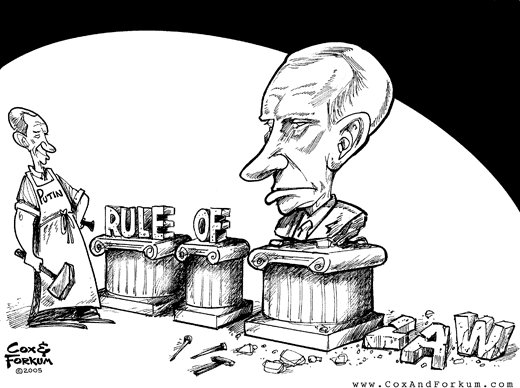
And so, with GM moving inexorably towards the Chrysler model of bankruptcy justice, as reported here, we bankruptcy professionals–lawyers, judges, and consultants alike–have to wonder, "whither the rule of law?"  Who knows, maybe there was something to that Thracymacus guy’s view that "might is right" and justice is "the interest of the stronger," and that because "in a state the Government is the strongest, it will try to get–and it will get–whatever it wants for itself."

***

Special thanks to the incredible editorial cartoonists, Cox & Forkum, for authority to use the inset cartoon from this 2005 post entitled Backsliding.

***

6/05/09 UpdateSee my analysis of the Chrysler Sale Opinion (Part I) here.

© Steve Jakubowski 2009

[Part I: Assessing the Financial Carnage; Part II – Testing the Limits of Section 363 Sales]

[6/09/09 UpdateSee also my analysis of the Chrysler Sale Opinion (Part I) and (Part II).]

Well, the initial pleadings have been filed, and Chrysler’s argument is essentially that it’s a "dead man walking."  In it’s opening memorandum of law in support of its motion to approve the sale, Chrysler argues that if the "sale" doesn’t close on the accelerated timetable proposed, it will wither on the vine, resulting in "a rapid and severe loss of value."  (Mem. at 10).  Surprisingly, though, Chrysler’s opening memorandum doesn’t squarely address the issue laid bare in my previous post and in the preliminary objection of the dissident lenders; that is, why isn’t the proposed transaction a sub rosa plan of the kind prohibited under the law of the Second Circuit?

In dancing around this question, Chrysler’s lawyers submit a two-pronged response, arguing that the transaction should be approved because, first, Old Chrysler is receiving "fair consideration" in the transaction and, second, Chrysler’s going concern value will be preserved, jobs will be retained, and an extensive network of independent dealers and suppliers will live to see another day.  Chrysler’s opening memorandum of law, however, does not address the important question of why, absent the consent of the dissident lenders, 65% of the equity in New Chrysler should go to junior creditors in satisfaction of their respective claims against Old Chrysler while the claims of senior dissenting lenders go unpaid?

One thing’s for sure, Chrysler’s (and soon GM’s) court battles will afford us a rare opportunity to witness one of bankruptcy law’s most fundamental questions being litigated in the highest stakes battles of all time, that being:

When does the "absolute priority rule" (compare FRB-Cleveland’s strict construction of the rule back in 1996 here with the Administration’s position today), which establishes a hierarchy of recovery rights among creditor classes, take a back seat to the "fresh start," rehabilitative policy of chapter 11? 

Chrysler’s opening memorandum touched upon this question by focusing on the US Supreme Court’s classic pronouncement in NLRB v. Bildisco & Bildisco, 465 U.S. 513, 528 (1984), where the Court stated that the "fundamental purpose of reorganization is to prevent the debtor from going into liquidation, with an attendant loss of jobs and possible misuse of economic resources."  This principle, Chrysler argues, is paramount and (quoting NY’s judicial patriarch, Bankruptcy Judge Lifland, in the old Eastern Airlines case) "all other bankruptcy policies are subordinated" to it.  (Mem. at 4).

Many, however, will surely disagree with Judge Lifland’s statement from 20 years ago that all bankruptcy policies should be subordinated to the reorganization objectives of the Bankruptcy Code.  Indeed, even on a very practical level, as the authors of this 1997 article entitled "Chapter 11’s Failure in the Case of Eastern Airlines" note, such a policy is a failure:

Eastern Airlines’ bankruptcy illustrates the devastating effect of court-sponsored asset stripping-using creditors’ collateral to invest in negative net present value "lottery ticket" investments-on firm value.  During bankruptcy, Eastern’s value dropped over 50%. We show that a substantial portion of this value decline occurred because an over-protective court insulated Eastern from market forces and allowed value-destroying operations to continue long after it was clear Eastern should be shut down. 

Relying on Bildisco to establish an unwavering rule of law is also risky because Supreme Court jurisprudence on bankruptcy matters is anything but a seamless web.  Indeed, Ken Klee points out in his remarkable new book, Bankruptcy and the Supreme Court, Justice Rehnquist once wrote to Justice Stevens:  "I do not feel that I am qualified to make any sort of exegesis on the meaning of the Bankruptcy Code."  (Klee, p. 48).

For those looking for some alternative Supreme Court pronouncements favoring the dissenting lenders, consider Raleigh v. Ill. Dep’t of Rev., 530 U.S. 15, 24-25 (2000) (argued in victory by now Chicago Bankruptcy Judge Ben Goldgar), where the Court stated:

Bankruptcy courts are not authorized in the name of equity to make wholesale substitution of underlying law controlling the validity of creditors’ entitlements, but are limited to what the Bankruptcy Code itself provides. 

Consider also these two important pronouncements in Howard Delivery Serv., Inc. v. Zurich American Ins. Co., 547 U.S. 651 (2006) (pdf) (discussed at length in this previous blog post), where Justice Ginsburg, writing for a 6-3 majority, stated:

In holding that claims for workers’ compensation insurance premiums do not qualify for § 507(a)(5) priority, we are mindful that the Bankruptcy Code aims, in the main, to secure equal distribution among creditors. We take into account, as well, the complementary principle that preferential treatment of a class of creditors is in order only when clearly authorized by Congress…. (Id. at 655-56)

[W]e are guided in reaching our decision by the equal distribution objective underlying the Bankruptcy Code, and the corollary principle that provisions allowing preferences must be tightly construed….  Any doubt concerning the appropriate characterization [of a bankruptcy statutory provision] is best resolved in accord with the Bankruptcy Code’s equal distribution aim.  We therefore reject the expanded [i.e., "plain meaning"] interpretation Zurich invites.  (Id. at 667) (citations omitted).

Let’s also not forget an absolute favorite of Chicago’s Chief Bankruptcy Judge Carol A. Doyle, Northern Pacific Railway Co. v. Boyd, 228 U.S. 482 (1913).  There, following the Panic of 1893, shareholders and bondholders combined in a proposed reorganization plan to transfer the debtor’s assets to a new company that they would own, while freezing out the railroad’s general unsecured creditors, whose priority fell between the bondholder and shareholder classes (proving, yet again, that the more things change, the more they really just stay the same).  The unsecured creditors argued (much like Chrysler’s dissident lenders today) that the foreclosure sale contemplated by the plan "was the result of a conspiracy between the bondholders and shareholders to exclude general creditors" from the new company.  The trial court overruled the unsecured creditors’ objection, holding that (as argued by Chrysler and the Administration today) because the debtor was insolvent and there was no value for unsecured creditors (or in this case, the dissident lenders), the unsecured are entitled to nothing.  The Supreme Court, however, reversed in a 5-4 opinion written by Justice Joseph Lamar (see 4/29/1913 NY Times article), in which he stated:

If the value of the road justified the issuance of stock in exchange for old shares, the creditors were entitled to the benefit of that value, whether it was present or prospective, for dividends or only for purposes of control.  In either event it was a right of property out of which the creditors were entitled to be paid before the stockholders could retain it for any purpose whatever. 

This conclusion does not, as claimed, require the impossible, and make it necessary to pay an unsecured creditor in cash as a condition of stockholders retaining an interest in the reorganized company.   His interest can be preserved by the issuance, on equitable terms, of income bonds or preferred stock.  If he declines a fair offer, he is left to protect himself as any other creditor of a judgment debtor; and, having refused to come into a just reorganization, could not thereafter be heard in a court of equity to attack it. 

Nowadays, collusive efforts to squeeze out the dissenting middle are often called "reverse cramdowns."  As noted in this previous blog post, the Third Circuit held that plans proposing such "reverse cramdowns" may violate the so-called "absolute priority rule."  More significantly, however, the Second Circuit in Motorola, Inc. v. Official Comm. of Unsecured Creditors (In re Iridium Operating, LLC), 478 F.3d 452 (2007), recently addressed attempts to squeeze out the middle in the context of a settlement that the debtor sought to have approved under Bankruptcy Rule 9019.  While the Court in that case approved the settlement, it provided critical guidance in gauging the authority of Judge Gonzalez to approve the proposed "sale" transaction in contravention of the requirements of the absolute priority rule.  The court stated:

Continue Reading Chrysler Bankruptcy Analysis – Part III: Will The “Absolute Priority Rule” Kill The Sale?

[Part I: Assessing the Financial Carnage; Part III: Will the Absolute Priority Rule Kill the Sale?]

[6/09/09 UpdateSee also my analysis of the Chrysler Sale Opinion (Part I) and (Part II).]

"Be careful what you wish for," the old saying goes, and so too for those who wished for Chrysler to file for bankruptcy in order to achieve their objectives.  Chrysler and all its major constituents will argue that the house is on fire and absent a quick sale on the agreed-upon terms (well summarized in this Treasury release), asset values (whatever’s left of them) will be irrevocably destroyed.  The dissident lenders will argue that the fire is an ingenious illusion meant to force them to accept a deal that denies them their first priority rights to Chrysler’s assets and is merely a disguised plan of reorganization that a Court has no authority to approve in the 363 sale context.

So what’s the risk for the proponents of the sale?  As Chrysler’s own counsel at Jones Day wrote in this 2002 publication:

[U]nder certain circumstances a debtor may sell all or substantially all of its assets without making the sale part of a plan of reorganization. Where a chapter 11 debtor proposes to sell its assets or business "outside of a plan of reorganization," creditors are entitled to notice of the sale and an opportunity to voice any objections they may have with the court. However, the sale will not be subject to the same creditor disclosure and voting rights attendant to a sale as part of a plan of reorganization. Moreover, the proposed sale will be subject to the less exacting "business judgment" standard of review. For this reason, some courts refuse to approve a proposed sale outside of a plan of reorganization if it appears that the transaction is really a "sub rosa" or "de facto" plan because the terms of the sale will necessarily dictate the provisions of any future plan.

You don’t have to be a bankruptcy maven to see from the face of the term sheet that the proposed sale dictates the provisions of a future plan of reorganization and sure has the feel of a "sub rosa" or "de facto" plan under which:

  • Lenders with a first priority interest in Chrysler’s assets will receive $2 billion, nothing more.
  • The junior VEBA claimants will receive a $4.6 billion note payable over 13 years at a 9% rate of interest and additionally will receive 55% of the equity of New Chrysler.
  • Unsecured trade payables of about $1.5 billion get paid in full.
  • The US Treasury will receive 8% of the equity of New Chrysler as repayment of its $4 billion junior TARP loan while the Canadian government gets a 2% stake for its junior loans.

What’s the governing law?  Well, since the case was filed in New York, the law of the Second Circuit Court of Appeals applies.  The latest pronouncement from the Second Circuit on whether 363 sales are disguised "sub rosa" plans came in Motorola, Inc. v. Official Comm. of Unsecured Creditors, 478 F.3d 452 (2007), where the Court wrote:

The trustee is prohibited from such use, sale or lease if it would amount to a "sub rosa" plan of reorganization.  The reason "sub rosa" plans are prohibited is based on a fear that a debtor-in-possession will enter into transactions that will, in effect, “short circuit the requirements of [C]hapter 11 for confirmation of a reorganization plan.”  Pension Benefit Guar. Corp. v. Braniff Airways, Inc. (In re Braniff Airways, Inc.), 700 F.2d 935, 940 (5th Cir. 1983).  In this Circuit, the sale of an asset of the estate under § 363(b) is permissible if the “judge determining [the] § 363(b) application expressly find[s] from the evidence presented before [him or her] at the hearing [that there is] a good business reason to grant such an application.”  Comm. of Equity Sec. Holders v. Lionel Corp. (In re Lionel Corp.), 722 F.2d 1063, 1071 (2d Cir. 1983).

The Court noted in a footnote a "number of factors that a judge might consider when determining whether there is a ‘business justification’ for the asset’s sale."  These factors include, but are not limited to, the following:

Continue Reading Chrysler Files Bankruptcy – Part II: Testing The Limits Of Section 363 Sales

[Part II – Testing the Limits of Section 363 Sales; Part III: Will the Absolute Priority Rule Kill the Sale?]

[6/09/09 UpdateSee also my analysis of the Chrysler Sale Opinion (Part I) and (Part II).]

And so, with these fighting words by President Obama, Chrysler files for bankruptcy in the Bankruptcy Court for the Southern District of New York.  Clearly, we’re in uncharted waters as never has the Office of the President become so engaged in the restructuring of America’s largest businesses.  In supporting Chrysler’s filing, a visibly angry President Obama came out swinging, stating:

A group of investment firms and hedge funds decided to hold out for the prospect of an unjustified taxpayer-funded bailout. I don’t stand with those who held out when everyone else is making sacrifices. They were hoping that everybody else would make sacrifices and they would have to make none. We will use the bankruptcy laws to clear away remaining obligations. It will be designed to deal with the last remaining holdouts. It was unacceptable to let a small group of speculators endanger Chrysler’s future by refusing to sacrifice like everyone else.

For his part, Congressman John Dingell, the longest serving member of the House, promised that “[t]he rogue hedge funds that refused to agree to a fair offer to exchange debt for cash from the U.S. Treasury – firms I label as the ‘vultures’ – will now be dealt with accordingly in court."

The secured debt holdouts didn’t see things quite the same, obviously, and issued this statement justifying their holdout, saying:

[W]e offered to take a 40 percent haircut even though some groups lower down in the legal priority chain in Chrysler debt were being given recoveries of up to 50 percent or more and being allowed to take out billions of dollars. In contrast, over at General Motors, senior secured lenders are being left unimpaired with 100 percent recoveries, while even G.M.’s unsecured bondholders are receiving a far better recovery than we are as Chrysler’s first lien secured lenders. We have a fiduciary responsibility to all those teachers, pensioners, retirees and others who have entrusted their money to us. We are legally bound to protect their interests. Much as we empathize with Chrysler’s other stakeholders, the capital is just not ours to contribute to their cause by accepting a deal that is outside the well-established legal framework and cannot be rationalized as being commercially reasonable.

So the petition is now filed.  Let’s examine the carnage:

Continue Reading Chrysler Files Bankruptcy – Part I: Assessing The Financial Carnage

NPR’s Planet Money, which interviewed me in this podcast last November about how the US government might get involved in a GM bankruptcy, called again asking for my thoughts on recent developments in GM’s restructuring saga, particularly now that the Obama administration has become so engaged in attempting to dictate the results.

You can hear some of my comments in this latest podcast, just released today.  The interview starts at 6:16 minutes into the podcast.  Be sure to also listen to the fine introductory song, The Fear, by Britain’s Lily Allen (full version and lyrics here).

Many thanks to Kathleen Brooks, David Kestenbaum, Laura Conway and the staff at Planet Money for the call and the opportunity to share some of my thoughts with others!

© Steve Jakubowski 2009

In June 2007, I wrote here about Judge Small’s opinion that BAPCPA’s expanded "safe-harbor" definition of "swap agreement" did not apply to ordinary supply agreements in which a seller and an end-user entered into a contract "for delivery of a product that happen[ed] to be a recognized commodity."  As such, Judge Small held, these contracts were not exempt from avoidance as fraudulent transfers (on the theory that the supply contracts were made for less than market value when the debtor was insolvent).

Well, to the delight of the ISDA, which filed an amicus brief in support of the appellant-purchasers of natural gas under various supply contracts with the debtor, the 4th Circuit yesterday reversed Judge Small and remanded with instructions that the Bankruptcy Court "allow the customers to attempt to demonstrate facutally and legally that their natural gas supply contracts were swap agreements based on the classification included in § 101(53B)."  Hutson v. E.I. du Pont de Nemours and Co. (In re Nat’l Gas Distribs., LLC), 2009 WL 325436 (4th Cir. 2/11/09) (pdf)

In reaching this decision, the 4th Circuit undertook to determine the meaning of "commodity forward agreements," and ultimately concluded that "the bankruptcy court in this case construed ‘commodity forward agreements’ too narrowly–i.e., by requiring that they be traded on an exchange and not involve physical delivery of the commodity."  In so doing, the 4th Circuit found:

  • First, that "the Bankruptcy Code does not require that a ‘forward contract’ [which necessarily is narrower in scope than "forward agreements"] be traded on an exchange or in a market";
  • Second, that the contracts at issue were not "simple supply contracts" because "they also were part of a series of contracts in which the customers hedged their risk of future fluctuations in the price of natural gas … that were only a part of a larger risk management program in which the customers ‘regularly use[d] forwards and other derivatives."
  • Third, that while BAPCPA’s legislative history, which Judge Small quoted, "does provide support for the notion that traditional supply agreements are not ‘swap agreements’ … the conclusion that the contracts in this case are traditional supply contracts overlooks the fact that the contracts in this case contained real hedging elements … [and thus] Congress did not preclude physical delivery in connection with a ‘commodity forward agreement,’ as defined in § 101(53B)(A)."

Notably, however, the Court "[did] not direct the bankruptcy court to find that the contracts in this case are ‘commodity forward agreements’ or ‘swap agreements.’"  Recognizing that § 101(53B) "contains its own counterintuitive definitions, as well as inconsistencies," the 4th Circuit would not attempt to provide its own definition.  Instead, it "point[ed] to certain nonexclusive elements that the statutory language appears to require," those being:

Continue Reading 4th Circuit Overrules Judge Small And Holds That Ordinary Commodity Supply Contracts Fall Within BAPCPA’s “Swap Agreement” Amendments

As if he doesn’t have enough to do as head of Levenfeld Perlstein’s restructuring group and as executive editor of the must-read ABI Journal, Jonathan Friedland has undertaken the gargantuan task, never yet accomplished, of assembling in a single treatise, entitled Strategic Alternatives for Distressed Businesses, the varied state law approaches to the liquidation and disposition of distressed businesses (including so-called "assignments for the benefit of creditors" or "ABC’s").
What motivated Jon to commit himself to this public service?  Apparently, frustration!  Now while most lawyers let out their frustrations on some hapless administrative assistant or airline gate agent, not so Jon, who writes:

This book was born out of frustration.  Beginning several years ago, I noticed that more and more companies in need of a restructuring or sale could afford neither the time nor cost of a Chapter 11.  My frustration came from the fact that I, like so many other lawyers who focus their practices on the representation of parties in Chapter 11 and out-of-court workouts, simply did not have the same rich resources of information at my fingertips with respect to nonbankruptcy alternatives for distressed business as I did with respect to bankruptcy.

The need for a book like this was brought home to me when, in several deals, we decided that we likely needed an Assignment for the Benefit of Creditors, and likely had the ability to do one in any of several different states.  I needed to understand the pros and cons of each state’s procedure.  I found that more information resided in the heads of a few people here and there than in any book.  I wanted a single volume that compiled relevant statutes from across jurisdictions.  I looked and looked, but there simply was nothing like that.  This book seeks to fill the void.

On this score, Jon is right.  Many state bar and continuing education associations have developed outlines covering a particular state’s law and practice regarding ABC’s (such as this excellent one covering ABC’s in Illinois).  Bob Eisenbach also has neatly summarized in this blog post "the ABC option," with links to various excellent works (including Geoffrey Berman’s 118 page practical guide, published by the ABI and now in its second edition, entitled General Assignments for the Benefit of Creditors: The ABC’s of ABC’s).  None, however, point to any comprehensive 50 state review of strategic alternatives to bankruptcy.

Jon’s role in this project is as principal author and editor-in-chief (or as he humbly calls it, "Chief Logistics Manager").  DSI’s Geoffrey Berman also lends his considerable talents as executive editor to the project.  26 other restructuring professionals from around the country (including such household names as Will Kohn, Carl Lane, Patty Redmond, and Nancy Ross) also joined to contribute to the 1,211 page treatise, which divides into the following sections:

Continue Reading Reviewing “Strategic Alternatives For Distressed Businesses” by Jonathan Friedland

12/9/08 UpdateWell, unlike Lehman, the more traditional complement of first day motions were filed late last night (docket here), including a critical vendor motion and a financing motion that authorizes it to continue selling its receivables through an amended securitization facility.  Here’s the 90 page supporting affidavit of Chandler Bigelow III, the Trib’s CFO, in support of all the first day motions, including a brief explanation of the liquidity events that forced the entire enterprise into chapter 11 and a nice chart at the back showing the corporate relationship among the various filing and non-filing subsidiaries.

          *                                  *                             *

I followed Lehman’s free fall into bankruptcy through a number of posts in the first week of Lehman’s case (start here).  Today, the Tribune Company performed its own spectacular free fall into chapter 11, taking not only itself down, but also another 111 subsidiaries (including The Chicago Tribune, WGN, The LA Times, KTLA. The Times Mirror, The Baltimore Sun, WPIX, and even forsalebyowner.com).

Like the Lehman chapter 11 filing, the Trib’s filing was accompanied by none of the motions one would expect to see at the outset of the case (such as for approval of use of cash collateral and a DIP lending facility, payment of basic employee benefits for accrued and unpaid wages, maintenance of its cash management system and business forms, and assumption of various customer programs, all accompanied by an affidavit of a senior executive explaining the cause of the filing and the need for the requested relief).

My guess is that the senior secured lenders, led by JP Morgan Chase, as agent for a host of banks and hedge funds in an $8.571 billion senior credit facility (compared with stated total assets of $7.6 billion), are balking at management’s business plan for the near- and long-term, and have been unable to reach agreement with management over the terms by which the Trib and its subsidiaries would have access to cash to fund operations during the case.  Given the widespread recognition that DIP lending facilities simply have dried up, this standoff comes as no surprise.  Until then, the Trib’s operations will run on fumes supplied by the goodwill of its trade vendors and employees.

Here’s the Tribune Company’s voluntary petition, and here’s the docket in the Trib’s main case, which as of 5:30pm EST has a single entry, that of the petition.  Though the other 111 or so subsidiaries identified in the Trib’s petition are listed as co-debtors, none of these entities have yet filed their respective individual petitions, thus potentially enabling three wily creditors of each subsidiary to really throw a wrench in the works by filing an involuntary petition against that subsidiary in a venue other than Delaware (where the parent Tribune Company filed its petition).

Most people in Chicago were appalled by last summer’s dramatic changes to the layout of The Chicago Tribune.  I wonder what’s going to show up tomorrow. 

© Steve Jakubowski 2008